Wednesday, November 30, 2022

Thanksgiving Survey 2022: Water - Responses

 Thanksgiving survey: Water - Responses

The family mentioned the Nile River, the Dead Sea, and the human body several times.

Question 1.

Name a body of water (of any size) for which you are thankful.


A.  The Quabbin Reservoir.


B. Rocky River because it provides beautiful scenery in our metroparks and I have walked there many times. 


C. The water in my 32 oz emotional support water bottle 


D. Done. 


E. I am very thankful for small droplets of water 1 micron in volume, as they are the average volume of a cell and are thus very central to my work.


F. The water in the kettle from which I make my tea.


G. My own body, which is mostly water.


H. I am thankful for the clean water that comes out of my tap, and for clean filtered water that comes out of my refrigerator.   I am thankful for all the bodies of water on the planet that are still capable of supporting life.


I. The C&O canal


J. [Family member], who is 70% water.


K.  [Redacted] Lagoon in Belize


L.  The White River (good for jumping in)


Question 2.

Name a famous body of water, and why it is significant.


A.  The Okefenokee Swamp, in southern Georgia.

Because this is where Pogo famously uttered his anti-pollution motto, “We have met the enemy and he is us”.


B. Sea of Tranquility, which is where astronauts landed on the moon.


C. De Nile, because it’s not just a river


D. All famous bodies of water I know of already have names.


E. The Hamza river is really cool, even if it’s not as famous as the Amazon river, because it’s bigger than the Amazon and all underground! It even flows underneath the Amazon, 4 km down! If we could get down there, think of all the dinosaurs we could find!


F. The Dead Sea.  Also called the Sea of Death (Yām HaMāvet ים המוות),  The Sea of Salt (Yām HaMelaḥ ים המלח),  and the Sea of Lot (Birket Lut بحر لوط).   Swimming in it is a singular experience.  Once you have gone in it, you will not ever need to nor want to do that again.


G. The Nile River, significant for being the center of one of the world's oldest civilizations, as well as the first stage of grief.


H. The Nile river because it enabled one civilization to flourish. The Red Sea because it has fish and whales and is part of our origin story as Jews.

The Pacific, because it contains the islands of Hawaii.


I.   A man, a plan, a canal: Panama!


J. The Dead Sea in Israel, because I got to go float in it, and that was pretty cool.


K. Sargasso Sea. It introduced me to Jane Eyre.


L. Crater Lake in Oregon is significantly deep.


Family members:  mostly water,
especially the younger ones


Thursday, November 17, 2022

Thanksgiving Survey 2022: Water


The Sea of Galilee

For the eleventieth year in a row, It's time for the Common Household time-honored tradition of the


Thanksgiving survey:  

WATER


1. Name a body of water (of any size) for which you are thankful.


2.  Name a famous body of water, and why it is significant.


Please participate by giving your answers in the comments.  Happy Thanksgiving Preparation Week!


As you can see, I could not pick one favorite photo for this topic.

New Brunswick, Canada

Wetlands sign, Allegheny County, PA

North Park, Allegheny County, PA

Roman aqueduct, Israel


A drawing by my father for 
a class lesson he was teaching


Refreshment for voter
registration volunteers


Oregon Ridge Park, Maryland
Alas, this lovely swimming hole is no more.

Sunday, November 6, 2022

First lines: October 2022 edition


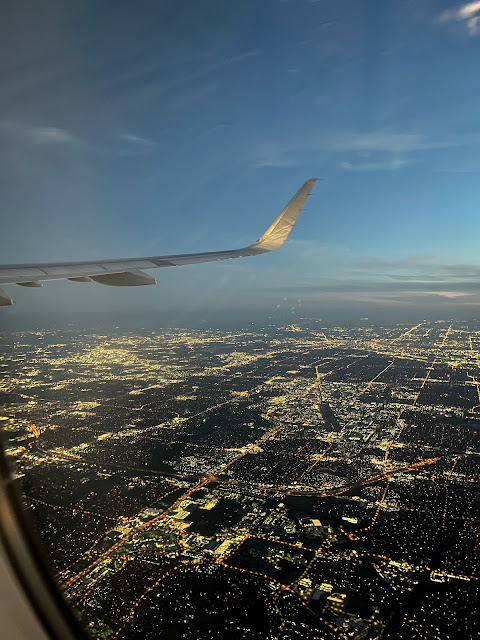
One of many non-hot-air-balloon flights we were on in the last few
days of October.  I think this is Dallas, TX.

Below are the first lines of the eight (!) books I finished reading in October. This is a stupendous number of books for me, caused by the confluence of needing to switch to children’s lit, and having two cross-country travel days.


Book 1
September 1953
Turtle Mountain Jewel Bearing Plant

Thomas Wazhashk removed his thermos from his armpit and set it on the steel desk alongside his scuffed briefcase.


Book 2
Hi, I’m Sadiq! My family and I live in Minnesota, but my parents are from Somalia.


Book 3
Chapter 1: The Ridiculous Hat

“Force…equals…mass…times…acceleration,” muttered Ada as she wrote in her notebook. Ada pondered that if you drop a hammer on your foot, it hurts more than dropping, say, a sock on your foot. The acceleration, or speeding up, is the same, but the mass, the solid oomph of a thing, is different. Oomph times zoom equals kaboom!


Book 4
Chapter 01: An Unexpected Sofa

The sofa wasn’t there on Monday but it was there on Tuesday. It sat in the shade just down the road from the bus stop.


Book 5
On Nov 4, 2008, when many world leaders waited to hear the results of the American presidential election, Italian prime minister Silvio Berlusconi was in his Roman residence preparing to have sex.


Book 6
Chapter 1: Disarming

“Did!” Ada growled through gritted teeth. She shirred the black iron coal shovel down through the air at her sister.


Book 7
Part One: Meet New People and Try New Things
Joyce

Well’ let’s start with Elizabeth, shall we? And see where that gets us?


Book 8
Chapter One: The Lady in the Drawing Room

“Grrh, I’m a bear! Grrh, grrh, I’m a bear, Dorkie!”

“Oh, dear, so you are! Wotever shalladoo!”


Did not finish
Just as Lucien Bernard rounded the corner at the rue la Boetie, a man running from the opposite direction almost collided with him. He came so close that Lucien could smell his cologne as he raced by.


The titles and authors revealed:


Book 1
The Night Watchman by Louise Erdrich. 464 pages. Published 2020. (Pulitzer prize winner)

This second reading was for book club. I found the book even better the second time around – I love the characters and the magical realism of this book. It also taught me about a piece of US history that every American should know. Highly recommend.


Book 2
Sadiq and the Big Election, by Siman Nuurali, Art by Christos Skaltsas. Published 2022. 50 pages. Children’s picture book. Has a glossary, discussion questions, and activities for kids.

I desperately needed something short and light. I find that at bedtime I cannot read about French collaborators during the Nazi occupation (see “Did not finish” category). But it also seems that I cannot escape elections as a topic, because this book popped up near the top of the list as available from the library on kindle.


Book 3
The Case of the Missing Moonstone: The Wollstonecraft Detective Agency Series, Book 1, by Jordan Stratford, illustrated by Kelly Murphy. Published 2015. 216 pages.

This was a fun children’s detective story, which puts together two girls from history who did not actually know each other in real life. Ada Byron (who became Ada Lovelace, known as the world’s first computer algorithm designer) and Mary Godwin (who became Mary Shelley, known as the world’s first science-fiction author). Other historical characters also appear, and there is a splendid hot-air balloon adventure.


Book 4
What We Found In The Sofa and How It Saved The World, by Henry Clark, Illustrated by Jeremy Holmes. 368 pages. Published 2013. This middle-reader book also features a wild hot-air balloon ride. This book is more sci-fi fantasy than the other kid’s book. Includes an A.I. couch, cloning, an evil alien, and shenanigans.


I don't have a photo of a hot-air-balloon.
But I do have this photo of wet balloons
during a marching band parade.


Book 5
Strongmen: Mussolini to the Present, by Ruth Ben-Ghiat. Published: November 10, 2020. Text 262 pages. With notes, index, etc, 358 pages.

Terrifying, but instructive. I had to gloss over some sections which were just too awful. Warning: this book contains graphic descriptions of violence, including sexual violence.

The book is a case study of some of the more well-known autocratic rulers of the 20th and 21st (so far) centuries, but is limited to those who came to power through elections or coups. There is nothing in this book about Stalin, Mao, Xi, or the Kims of North Korea, because they came to power in already-closed systems. It turns out Trump’s personality flaws are not a quirk but a feature of the “personalist”/ autocratic type ruler. Ben-Ghiat published this before the Jan 6, 2021 insurrection but does note that in general the strongman ruler will do just about anything to stay in power or return to power.


Book 6
The Case of the Girl in Grey: The Wollstonecraft Detective Agency Series, Book 2. By Jordan Stratford, illustrated by Kelly Murphy. Published 2016. 226 pages.

The Strongmen book was very difficult subject matter so I was happy to turn to the second in this children’s lit series (Grades 4-6). Starring Ada Lovelace and Mary Shelley as children. Contains harmless ghosts, graves, and doppelgangers.


Book 7
The Thursday Murder Club By Richard Osman. Published 2020. 355 pages.

I did not like the narration style at the start of the book, but the narration/viewpoint changed frequently. Oddly, those changes did not bother me. I was eventually drawn in by the setting, and then the characters and the humor. The Old Folks’ Home portrayed in the book closely resembles the place where my parents spent their last days. Except the one in the book had a cemetery, with extra bodies in it. I am not a good judge of whether the mystery and solution thereof are satisfactory to die-hard (!) murder mystery fans; all I can say is that I enjoyed the story a great deal. It was good book to read while experiencing jet lag that just makes one want to loll around in the hotel and read.


Book 8
The Two Mrs. Abbotts (Miss Buncle Book 3) By D.E. Stevenson. Published 1943. 276 pages.

This book takes place and was written during World War II. I did not enjoy it quite as much as the 2nd book in the series. It includes a character who believes in judging a person’s character by the size and shape of the head – eugenics? – and that irked me. But it ends with a traditional couple falling in traditional love, so that’s okay to read while cooped up in an airplane for 4 hours.


Side note: If you get on an airplane departing from Texas, keep your face mask on. It was our last flight home after a wedding, and I was thinking I could take off my mask, but as soon as we took off, people starting coughing and kept it up for the entire 2.5 hour flight. My mask stayed on, and now, 6 days later, I am not sick.


Did not finish
The Paris Architect by Charles Belfoure. Published 2013. 400 pages.

For book club. A fictional exploration of the Nazi occupation of Paris, with particular attention given to French collaborators with the Nazis. I got about half-way through (after the scene with the fireplace), but this book was too fraught with peril for me to finish. And that’s too bad, because I think it is important to understand what it means to be a collaborator.


Monday, October 3, 2022

First Lines: September 2022 edition


Below are the first lines of the books I finished reading in September.


Book 1

I would like to say a few things about my first husband, William.


Book 2

We had better move, said Mr. Abbott casually. 


Book 3

Before we talk about anything else, can we just start with awe?  I am completely in awe of this moment we’re having right now --  you and me.  When I was younger, disability didn’t seem to exist outside my visits to the hospital and seating clinics for repairs on my wheelchair.


Book 4

There was a stand-up special ten or fifteen years ago called Welcome to Turtle Island.


Book 5

To prohibit illicit carnal intercourse between Europeans and natives and other acts in relation thereto.


Did not finish 

Prologue

Every age hath its consolations, as well as its sufferings.  – Adam Ferguson.

For a period of nearly half a century, from about the time of the Highland rebellion of 1745 until the French Revolution of 1789, the small city of Edinburgh ruled the Western intellect.  For near fifty years, a city that had for centuries been a byword for poverty, religious bigotry, violence and squalor laid the mental foundations for the modern world.


The titles and authors revealed:


Book 1

Oh William! By Elizabeth Strout. Published 2021.  240 pages.

Interesting characters, although they are not particularly happy.  Excellent writing.  I was quite distracted while reading it, so I probably didn’t enjoy it to its fullest.   It was extremely well received in book club.  I thought the portrayal of rural New England was spot on.


Book 2

 Miss Buncle Married, by D.E. Stevenson.  Published 1936, 352 pages.

The second in a series about Barbara Buncle, now married and living in a different small village in England in the 1930s.  I enjoyed this one even more than the first one. This book is part of the Furrowed Middlebrow set of books.   Sometimes I need to unclench my jaw, and the Furrowed Middlebrow collection is exactly right for those times. 


Book 3

Sitting Pretty, by Rebekah Taussig.  Published 2020, 256 pages.

I read this in order to educate myself about how people with disabilities interact with the world.  This book was a good start, and I recommend it.   I still have plenty more to learn.


Book 4

We Had a Little Real Estate Problem: The Unheralded Story of Native Americans & Comedy by Kliph Nesteroff.  Published 2021.  336 pages. 

I am the least likely person to read a book about comedians.  However, the author of this book kept me interested.  The last few chapters were especially relevant.  The text of the book is far less than 336 pages.  At the end of the chapters there are many photos, followed by notes and an index.


Book 5

Born a Crime, by Trevor Noah.  Published 2016.  289 pages.

I first read this book in June 2017.  I am re-reading it as an assignment from my church’s anti-racism group.  Trevor Noah was a toddler when the apartheid system was coming to an end in South Africa.  Our group is hoping that his insights about the apartheid system and the aftermath will be instructive to us.


Did not finish 

Crowded With Genius:  The Scottish Enlightenment: Edinburgh’s Moment of the Mind, by James Buchan.  Published 2003. 340 pages of text.  436 pages with notes and index.  

I enjoyed the start of this book, with its descriptions of then back-water town of Edinburgh, Scotland.  But I soon found the book was too dense and confusing and I didn’t get past the first chapter. I think I would need to already know a lot of Scottish history to make sense of this book.  The court in Edinburgh was called The Session, which makes me wonder if this is where the Presbyterian Church got its terminology for the governing board of local congregations.


Please do tell -- what are you reading these days?


Sunday, September 4, 2022

First Lines: August 2022 edition

I didn't have any photos of Wuthering Heights
so we will have to make do with this photo
of Golan Heights


These are the first lines of the books I finished reading in August.  If there is a theme this month, it could be “Books That Reminded Me of Wuthering Heights In Some Way.”  Three of this month’s books did, anyway.


Book 1

Shadow had done three years in prison.  He was big enough, and looked don’t-fuck-with-me enough that his biggest problem was killing time.


Book 2

One tree is like another tree, but not too much. One tulip is like the next tulip, but not altogether. More or less like people—a general outline, then the stunning individual strokes.


Book 3

When I was six, my father took me to Grand Central Terminal in New York to see the imposing bronze statue of my great-great-great grandfather “Commodore” Cornelius Vanderbilt.


Book 4

The Piano Teacher’s Pupil

‘The Brahms?’ she said.  ‘Shall we struggle through the Brahms?’  The boy, whose first lesson with Miss Nightingale this was, said nothing.  But gazing at the silent metronome, he smiled a little, as if the silence pleased him.


Book 5

From above, from a distance, the marks in the dust formed a tight circle.  The circle was far from perfect, with a distorted edge that grew thick, then thin, and then broke completely in places.  It also wasn’t empty.


Book 6

Chapter One:  Breakfast Rolls

One fine summer’s morning the sun peeped over the hills and looked down upon the valley of Silverstream.  It was so early that there was really very little for him to see except the cows belonging to Twelve-Trees Farm in the meadows by the river. 


The titles and authors revealed:


Book 1

American Gods by Neil Gaiman.  First published 2001 (465 pages).  10th Anniversary edition, with 12,000 additional words, published in 2011.   565 pages.

I read this for book club.  My review at this link.   It is like Wuthering Heights in that I didn’t love reading the book, but I keep thinking about it.


Book 2

 Upstream by Mary Oliver (essays by the poet).  2016.  187 pages.

This book provided a lovely respite from the world.   I was completely in the mood for these essays, which feature discussion of nature and a few American writers.  This book was not in any way like Wuthering Heights.

This is my photo of a stream that is probably
 in New England, so close enough
 to Cape Cod, where Mary Oliver lived.


Book 3

Vanderbilt: The Rise and Fall of an American Dynasty

by Anderson Cooper  and Katherine Howe.   336 pages.  2021.

Pretty good read - exposé of a rich but unhappy family, the ancestors of Anderson Cooper, journalist for CNN TV news.  Cornelius Vanderbilt used some of his money to found the university that bears his name.  (6+ degrees of separation: I studied in France for a semester via the Vanderbilt-in-France program.)  A few generations later, the mother and daughter both had the same name – just like in Wuthering Heights.  I was confused about which Gloria was which, at any point. I guess this practice of parents naming their children after themselves is more prevalent than I had realized. 


Book 4

Last stories by William Trevor.  Published 2014.  240 pages.

Ten short stories, published posthumously (as near as I can tell). 

Short stories are not my favorite genre.  I read this to fulfill the Summer Library Bingo square for a book with the word “last” in the title. I tried two other books in this category, and they did not grab me at all.  


These are well-written stories, but with short stories I always feel that I am not able to get to know the characters well enough, and there is usually a macabre or sad twist to the plot.  I would like to read more by this author, if time permits.  His work made the shortlist for the Booker Prize five times.   It’s a stretch to relate these short stories to Wuthering Heights, but there was one story that takes place partly on a remote farm.


Book 5

The Lost Man by Jane Harper .  2019.  353 pages.

It’s about a dead man and his distrustful family, all in the stark and blazing-hot Australian outback. I thought it was well told, with interesting characters.  I started out with the audio book, because it was available, but it was hard to understand, because of the Australian accent.  I switched to the kindle version to finish it, but in my head the Australian accent was always rolling around.  


This book reminded me a lot of Wuthering Heights – both have a family that mistreats each other, who live off in the middle of nowhere, with very little interaction with the outside world.  I was fascinated to learn about The School of the Air, which is a real thing.  I read this book for book club, but sadly will not be able to attend the discussion.

I don't have a photo of the Australian outback, so
this photo of the Thar Desert in Pakistan will have to suffice.
The crowd includes my Mom, Dad, brother, me,
 and my father's cousin's family.
I am the one in the pink chunni (head scarf).
April 1990.


Book 6

Miss Buncle’s Book, by D.E. Stevenson.  Published 1934.  304 pages.

A book set in a small English village in the 1930s.  A woman in need of money writes a roman à clef about all the people in her town.  Matrons are insulted, barbs are traded, but nearly nothing of great consequence happens.  There is tea drinking and hot buttered toast and a happy ending.  It was a bit of a challenge to keep track of all the actual townspeople plus the fictional townspeople, but I didn’t worry about it too much.  The major villain is named Mrs. Featherstone Hogg.  This book is part of the Furrowed Middlebrow set of books.  I picked this one because it was available on Kindle from our library.


Did not finish 

Anxious People by Fredrik Backman.  2019. 400 pages. 

I might come back to it.  It was just too fraught at the beginning for me to get through to the better part.  Yes, I was too anxious to read a book about anxious people. The book club folks agreed with me about the beginning, but said about half-way through it became well worth it, and there was redemption.


As always, I love to hear what you are reading.