Showing posts with label Jesus. Show all posts

Thursday, March 6, 2025

Ashes to Ashes, Spoons to Spoons

Smash the patriarchy


How my Ash Wednesday went.


On Wednesday afternoon a kind person explained Spoon Theory to me.  The spoon is a metaphor for the mental - physical - spiritual energy each of us has in a day to devote to our daily tasks.  Imagine each of us is allotted a certain number of spoons for the day.  Some days, it can take a person, say, 5 spoons to just get out of bed; other days it takes that person zero spoons.  For some people, calling their Senator uses hardly any spoons; for me it’s a high spoon cost.  It always makes me nervous.


And then the kind person showed me what it says on her wall: “It is okay to run out of spoons.”  Given the frenetic pace I have been on, for political activity, I needed to hear this.  And it was refreshing to have Kind Person listen to me.


That blessed conversation ended.  I began to feel some nasty heartburn, something I hadn’t felt in a long, long time.  I realized that I had forgotten to take my heartburn medicine for three straight days, because I was distracted by the decline and fall of Western civilization.  Heartburn uses up some spoons, for sure.


That evening we set out for dinner and Ash Wednesday worship – my Jewish husband and I.  I wore the button (pin) that I have decided to wear everywhere.  It says, “No Kings” (see photo above).


We sat at a round table at a gathering of three local churches, eating delicious homemade soup.  Small talk with strangers is not my strong suit, but it is something society needs to help us get along.  At first we discussed the various soups - a safe and pleasant topic.  Then one person at our table – from a different church than mine – told us about his real estate endeavors - houses he has refurbished and rents out.  Excellent.  He has contributed to the common good through his business.  


Landlord Guy then went on to complain about how the county executive raised the real estate tax by 36%.  “But no, she wouldn’t cut jobs or cut county spending.  Instead my renters have to pay 36% more.”  I said nothing.  I don’t know this man at all, so I felt it was pointless to start an argument about taxes.  Someone else at the table said, Did you hear that the USAID money has been restored?  Landlord Guy responded, “I bet Chelsea Clinton is real glad about that!  All that money from USAID goes straight to the Clintons!”  I could not listen any more.  I got up quickly and left the table without saying a word. 


I suddenly had no spoons left. I went to the sanctuary.


Shortly after I left the table, the worship service started.  As I was in line to receive the imposition of ashes, the woman behind me tapped my shoulder and whispered to me, “I like your pin.”  My “No Kings” pin.  I was grateful and thanked her.  This woman restored to me a spiritual spoon. 


No kings but Jesus.


Saturday, May 7, 2022

The Gospel of John, Chapter 21: Breakfast


The Gospel of John, Chapter 21: Breakfast


Read Chapter 21 here.


Since the previous chapter ended with some final-sounding words, this actual last chapter serves as a kind of epilogue or postscript.  


By the Sea of Tiberias (perhaps more familiar to us by one of its other names - the Sea of Galilee) some of the disciples are gathered.  The group includes Simon Peter, Doubting Thomas, The Disciple Whom Jesus Loved (TDWJL), and a few others.  Simon Peter says “I am going fishing” and the others go with him.  They are fishing at night, from a boat, but they do not catch a single fish.


The narrator informs us of the time of day, which, as we have seen before, is likely significant: 

Just after daybreak, Jesus stood on the beach, but the disciples did not know that it was Jesus.  (verse 21:4)


This is similar to the other resurrection appearances - Jesus shows up, but the disciples do not recognize him immediately.  Jesus speaks first, asking them if they have caught any fish, and they say, nope.  He suggests that they cast their fishing net to the right side of the boat.  They do so, and their net is so full of fish they can hardly haul it in.   


At this moment, TDWJL recognizes Jesus and exclaims to Peter, “It is the Lord!”  The text says:

When Simon Peter heard that it was the Lord, he put on his outer garment, for he had taken it off, and jumped into the sea.  (verse 21:7)

It seems Pete is shocked and embarrassed. Because he is naked?  Because he doubts the resurrection?  We don’t know.  The other disciples drag the heavy net into the boat.


They all go ashore and find a charcoal fire there.  There is fish cooking, and some bread.  Jesus asks them to bring some of the fish they have just caught.  The text specifies that the net is full of large fish, 153 of them.  Another piece of miracle is that despite the huge haul, the net is not torn.


Jesus says “Come and have breakfast.”  A wonderful and simple invitation.  By this point, all the disciples recognize that it is the Lord.  Jesus gives them bread and fish.  The author notes that this is Jesus’ third resurrection appearance to the disciples.  Jesus’ appearance to Mary Magdalene doesn’t count, because she ain’t no disciple.  Or so the gospel author and centuries of tradition would have us think.


What do I love about this story?  I love it because it was one of my Mom’s favorite Bible scenes.  I love it because it’s breakfast, and cooked by Jesus.  I love it because Jesus is so down to earth and friendly.  He is quite unlike what we have seen in some of the earlier chapters of this gospel. I love it because it has a miracle involving fish.  I love it because Peter is impetuous, as always.  And I love that it is so specific about the number of fish caught.


Next we have the famous passage where Jesus offers Peter redemption from Peter’s three denials of Jesus on the night of his arrest.  Three times, Jesus asks Peter “Do you love me?”  This time, Peter is able to reply in the affirmative, three times.  Jesus has some instructions to go along with the redemption, and a dire prediction.  It’s worth sharing the whole dialogue:


When they had finished breakfast, Jesus said to Simon Peter, “Simon son of John, do you love me more than these?” 


He said to him, “Yes, Lord; you know that I love you.” 


Jesus said to him, “Feed my lambs.” A second time he said to him, “Simon son of John, do you love me?” 


He said to him, “Yes, Lord; you know that I love you.” 


Jesus said to him, “Tend my sheep.” He said to him the third time, “Simon son of John, do you love me?” 


Peter felt hurt because he said to him the third time, “Do you love me?” And he said to him, “Lord, you know everything; you know that I love you.” 


Jesus said to him, “Feed my sheep. Very truly, I tell you, when you were younger, you used to fasten your own belt and to go wherever you wished. But when you grow old, you will stretch out your hands, and someone else will fasten a belt around you and take you where you do not wish to go.” (He said this to indicate the kind of death by which he would glorify God.) After this he said to him, “Follow me.”

(verses 15-19)


And so we have circled back to the start of the gospel.  In 1:39, Jesus issues the simple invitation to the first disciples - “Come and see,” just as simple as “Come and have breakfast.”  In 1:42 Jesus says to Peter “You are Simon son of John.  You are to be called Cephas (Peter)”.  And here in Chapter 21 Jesus calls Peter “Simon son of John” just as he did at the start.  And in 1:43, Jesus says to another new disciple, “Follow me.”


It’s now the dawn of a new day.  We have an immense catch of fish.  We enjoy a hearty meal with close friends, sitting by the sea.  We have a renewed sense of purpose.  Given the particular week in which I am writing this, I find re-reading this story immensely comforting.  Jesus’ language is all about invitation and companionship and love; he does not use force or oppression.  “Come and have breakfast.” 


Although the story has circled back to the beginning, Jesus does not seek to return to how things were.  Jesus wants to move forward with love.


At the same time, Jesus’ words are perplexing.  Jesus reaches back to one of the major metaphors of the gospel – the sheep and the Good Shepherd – and assigns to Peter, and by implication us, the task of caring for his “sheep”.  There’s very little explanation on how to do that.  Would that we could live up to what Jesus is asking us to do!  Perhaps it’s good that Jesus didn’t spell it out to specifically, because how we tend the “sheep” now has to be different than what was needed in 1st century Palestine. Or in 17th century England, a time that at least one US Supreme Court Justice, curiously, feels is relevant to our jurisprudence.  Or in 21st century United States.


From Jesus’ prediction, Peter knows that it will not be all sweetness and light to be tending Jesus’ sheep.  


The next paragraph focuses on The Disciple Whom Jesus Loved and implies a kind of rivalry between Peter and TDWJL.  TDWJL had been following Jesus and Peter during their close conversation.  Peter asked Jesus, “Lord, what about him?”  (verse 22).  Jesus replies “If it is my will that he remain until I come, what is that to you?  Follow me!”  The implication is that TDWJL will not die, but then the narrator denies that is the meaning of what Jesus said.  Jesus is basically saying, never mind about the other disciple, you just keep your eyes on me and follow me.  


This week, powerful people in this country showed just how much they want to impose draconian abortion restrictions on all women, no matter the woman’s circumstances. I will interpret this passage about Peter and TDWJL (John 21:21-23) as showing us that Jesus does not make the same rules apply to everyone.  He is able to take into account the particulars of both Peter and John’s situation.  Jesus knows each person’s situation is unique.  Justice Alito, the rest of McConnell’s Handmaidens on the Supreme Court, and on down the line to state legislators - they have no qualms about applying the steepest penalty across the board regardless of the circumstances surrounding a pregnancy (but zero penalty for the man causing an unintended pregnancy! and zero intention to provide healthcare coverage for those involved!).


But I believe Jesus is able to see the need of the woman who has a miscarriage that looks just like an abortion attempt.  I believe Jesus is able to see the need of the woman in the 3rd trimester of pregnancy, very much intended, but who finds out something has gone wrong and her health is threatened.  I believe Jesus is able to see the need of the woman who already has three children, has an unintended pregnancy, and just lost her job and her health insurance, and can’t see how she will support another child.  I believe Jesus is able to see the need of the woman with an unintended pregnancy because a man raped and impregnated her.  The Jesus I worship will not oppress these women the way Justice Alito would.  And yes, forcing any of these women to give birth against their will is oppression.


Theodicy would address why these women end up in these horrible circumstances in the first place, but I'm not going there. There is no good answer to that question. In Jesus' prediction about Peter's fate, Jesus is acknowledging that horrible things happen.


In the final paragraph of the gospel the narrator reveals that he himself is The Disciple Whom Jesus Loved:

This is the disciple who is testifying to these things and has written them, and we know that his testimony is true. But there are also many other things that Jesus did; if every one of them were written down, I suppose that the world itself could not contain the books that would be written.  (verses 24-25)


Thus ends this reading of the Gospel of John.  Thanks be to God.  It was not an easy read, but I feel I have gained blessing from the reading of it.  


Sunday, April 17, 2022

The Gospel of John, Chapter 20: Resurrection


Read Chapter 20 here.

“Early on the first day of the week, while it was still dark, Mary Magdalene came to the tomb…” The chapter begins with these familiar words.


At key moments in the narrative, the Gospel of John makes a point of telling us when the action is occurring – early in the day, noon, or the night; in light or in darkness.  Light and darkness are also key metaphors in the gospel for spiritual vision or lack thereof.  At this moment in this gospel telling, the light of a new day is about to shine.


The other important thing to point out here, that is mentioned in nearly every Easter sermon, is that women are main characters here.  In this gospel, one woman is named.


To proceed with the story… Mary Magdalene sees that, surprisingly, the tomb is open - the stone has been rolled away from the entrance.  It doesn’t say she is alarmed but we can guess that she is, from what she does – she immediately runs back to Simon Peter and the disciple “whom Jesus loved” (TDWJL) and tells them that someone has taken Jesus’ body away.  She exclaims, “They have taken the Lord out of the tomb, and we do not know where they have laid him.”  The use of “we” implies that Mary M. had gone to the tomb with other people.


Peter and TDWJL run to the tomb. TDWJL gets there first and peeks in, noticing that the burial cloths are there.  Simon Peter catches up, and fully enters the tomb.  He sees that the cloth that had been on Jesus’ head was folded up, separate from the other cloths.  TDWJL then goes into the tomb.  “He saw and believed; for as yet they did not understand the scripture, that he must rise from the dead.”  I think in this sentence, “they” refers to the rest of Jesus’ followers, not including The Disciple Whom Jesus Loved.  


We can infer that what TDWJL believes in that moment is that Jesus is raised from death to life. Could it be that TDWJL is doing a little humble-brag?  Only the most advanced disciples believe in the resurrection right away.  In fact, it’s a relief to learn that it took time for most of the disciples to come to believe in the resurrection. 


The two disciples head back home, leaving Mary still at the tomb, crying.  She looks into the tomb and sees two angels, who ask her why she is crying.  She repeats what she told the disciples - they have taken him (Jesus’s body) away, and I don’t know where they have put him.  She turns around, and sees a person standing there.  It’s Jesus, but Mary does not recognize him yet.  Jesus asks, Why are you crying?  Whom are you looking for?  Mary thinks he is the gardener, and asks him where he has put the body.  


Then Jesus calls her by name.  “Mary!”  She recognizes him and exclaims, “Teacher!”  The text implies that Mary approaches Jesus, because next Jesus warns her “not to hold on to me, because I have not yet ascended to the Father.”  Jesus instructs Mary to go and tell “my brothers” (the disciples):  

“I am ascending to my Father and your Father, to my God and your God.”  (verse 17)

Mary goes to the disciples and tells them that she has seen The Lord, and tells them what he said to her.


I just realized that throughout this gospel, when the word “disciples” is used, my assumption has been that it refers to men.  Isn’t Mary Magdalene a disciple, a follower of Jesus?  It seems she is, or should be considered so, because Jesus entrusts to Mary the crucial message that he is alive, raised from the dead.  But I think this gospel is written with the assumption that the disciples are men.


When Jesus uses the phrase “my Father and your Father” he is reinforcing the unity he spoke of in his prayer in Chapter 17.  “All mine are yours, and yours are mine” (verse 17:10).  In verse  15:15 Jesus had moved from calling the disciples his servants to calling them his friends.  In this phrase in 20:17 Jesus is portraying himself as their brother.  In a sense, this brings us full circle back to chapter 1:  

But to all who received him, who believed in his name, he gave power to become children of God, who were born, not of blood or of the will of the flesh or of the will of man, but of God.  (1:12-13)


The story leaps to the evening of the same day.  The disciples are meeting together, locking the doors of the house where they are, because they fear the Jewish leaders who opposed Jesus.  Into that gathering Jesus appears and says, “Peace be with you.” (Verse 19)  


Jesus shows them his hands and his side – presumably the marks of his wounds from being nailed to the cross, and from where the soldiers pierced his side after he died.  Nowhere in the text of this gospel did it describe the process of nailing a person to a cross.  It is assumed that we know that is part of crucifixion.  


The wounds are proof that it is Jesus himself.  The disciples are overjoyed to see Jesus.  Jesus says again “Peace be with you,” and continues “As the Father has sent me, so I send you.”  The first part of this sentence must be further proof of Jesus’ identity, because he has said this very thing about a thousand times in this gospel.  But I think this is the first time in this gospel that Jesus sends the disciples.   The text, as usual, is enigmatic; it does not say exactly where he is sending them or for what purpose.  But we know from Chapter 7 that we should not make the same mistake the Pharisees made (verses 7:32-36).  Jesus is not talking about sending them to the grocery store.  This gospel’s theme is that Jesus was sent from the Father to bring light and life.  Now Jesus is sending the disciples out to bring the same to all. Jesus is sending them to carry out the new commandment to love one another.  That’s my interpretation, anyway.


Then Jesus breathes on the disciples and says:

 “Receive the Holy Spirit.  If you forgive the sins of any, they are forgiven them; if you retain the sins of any, they are retained.”  (verse 22-23)

This is quite a gift Jesus is giving.  Jesus had already spoken to the disciples about the gift of the Holy Spirit (14:15-17,  14:25, 15:26, 16:7-13).  But this verse is the only time the word “forgive” appears in the entire Gospel of John (in the NRSV). Will the disciples be careful not to misuse their new power to forgive or retain sins?


One of the disciples was not in that locked room when Jesus appeared – Thomas.  The other disciples tell Thomas they have seen the resurrected Jesus, but he doesn’t believe them.   Thomas declares that he must physically see and touch where the crucifixion nails went into Jesus’ hands and feet, and where the soldiers stuck a spear in his side.  Hence the nickname that he has been stuck with throughout the centuries:  Doubting Thomas. Seems unfair, as in Chapter 11 Thomas was the first one to volunteer to walk into danger with Jesus.


A week passes, and again the disciples are gathered together, with Thomas among them this time.  Jesus appears and says “Peace be with you.”  He invites Thomas to see and touch his hands and his side.  “Do not doubt but believe.”   And Thomas does believe.  Jesus speaks of future believers:

“Blessed are those who have not seen and yet have come to believe.” (verse 29)


The gospel author notes that Jesus did other “signs” but they are not recorded here. The purpose of what is written in this gospel is: 

so that you may come to believe that Jesus is the Messiah, the Son of God, and that through believing you may have life in his name. (verses 30-21)


Those two verses sound like the end of the gospel, but there is one more chapter.


Friday, April 15, 2022

The Gospel of John, Chapter 19: Crucifixion


The Gospel of John, Chapter 19: Crucifixion


Read Chapter 19 here.


The torture and humiliation now begin in earnest.  And so does the political maneuvering between the Jewish leaders and Pilate, the Roman governor.  There is a tragic sense of fatalism - everything is happening as it has to happen, everyone is playing their allotted role.  Numerous times in this chapter the author tells us that scripture is fulfilled.


First, Pilate has Jesus whipped.  That in itself should be enough torture, but it doesn’t stop there.


Since Pilate has repeatedly called Jesus “King of the Jews”, the soldiers mock Jesus by making a crown of thorns and torture Jesus by putting this painful thing on his head.  They dress him in a purple robe, sarcastically say “Hail, King of the Jews”, and slap Jesus in the face.  


Pilate appears again before “them” (I surmise that this means the Jewish leaders who arrested Jesus and brought him to Pilate).  Jesus appears before them all, wearing the crown of thorns and the mocking robe of “royalty.”  Pilate twice says that he finds nothing to accuse Jesus of.  The chief priests and police call out “Crucify him!” and say that Jesus’ crime is that “he has claimed to be the Son of God.” (verse 7)


Pilate becomes afraid.  I guess he doesn’t want to get mixed up in a religious-political dispute.  Or he doesn’t want to choose between dissing the emperor or dissing the God of the Jewish people.  Pilate quizzes Jesus again, trying for a third time (a mirror image of Peter’s three denials?) to find a reason to free Jesus, but Jesus says nothing.  Pilate says, don’t you know I have supreme power over your life?  Jesus then responds that the only reason Pilate has power is that it was given to him “from above.”  


Again Pilate tries to release Jesus.  The Jewish leaders who oppose Jesus throw it back in his face - they say, if you let free this man who claims to be a king, then you are being disloyal to the Roman emperor.


Next Pilate tries to appeal to the people outside the Praetorium.  Are these just the Jewish leaders, or is it a crowd of people?  I think in this gospel it’s just the leaders.  The text notes that it was the “day of Preparation for the Passover, and it was about noon.”  I am not sure what this detail means. Is there likely to be a big crowd there at that time on that particular day? 


Pilate said to “the Jews”, (the leaders who oppose Jesus), “Here’s your king!” but they shout for Jesus to be crucified.  Pilate:  You want me to crucify your king?  The chief priests declare that the Roman emperor is their only king. So Pilate sends Jesus to be crucified.


As this gospel tells it, Jesus has to carry his own cross, walking to The Place of the Skull, Golgotha, the place of the crucifixion. 


There are few details in this gospel about the mechanics of crucifixion, but suffice to say that it is an extremely cruel, humiliating, and torturous way to die. They place Jesus on a cross between two other criminals.  Pilate arranges for a sign to be on Jesus’ cross that says, “Jesus of Nazareth, King of the Jews.” The text specifies that the sign is written in Hebrew, Latin, and Greek. Anybody and everybody should be able to read it.  The Jewish chief priests object to this label, but Pilate says, too bad.  “What I have written I have written.”  (verse 22).  


As Jesus hangs naked on the cross, slowly dying, the soldiers take Jesus’ clothes and divvy them up between them.  This is to fulfill a scripture.


Some of Jesus’ closest family and friends are standing nearby watching.  The first mentioned are women – Jesus’ mother, his mother’s sister, another Mary, and Mary Magdalene.  Jesus sees his own mother and “the disciple whom he loved” and bequeaths to his mother a new son, the disciple he loves.  This is heartbreakingly touching, and I think it is further fulfillment of Jesus’ prayer in Chapter 17:12 that “not one of them [Jesus’ followers] was lost”. 


Jesus senses that his death is near.  He says, in order to fulfill scripture, “I am thirsty.”  Those in charge put a sour-wine-soaked sponge on a branch of hyssop and hold it to Jesus’ mouth.

When Jesus had received the wine, he said, “It is finished.”  Then he bowed his head and gave up his spirit. (verse 30)


Every Good Friday, when I hear this story again, it never fails to give me chills.


The gospel author notes that “the Jews” do not want the bodies of the crucified people to remain on the crosses during the sabbath.  This next detail is gruesome, and does not appear in the other gospels.  In an additional cruelty, the soldiers break the legs of the two crucified criminals.  I looked this up, and the internet says that breaking the legs makes the crucified victims suffocate, and so would hasten death.  It would be less painful, I’m sure, if the soldiers just ran them through with a sword. But this is the Roman system of punishment, and the point is to make the punishment as cruel as possible. 


But Jesus is already dead, so the soldiers do not break his legs, which the text says is a fulfillment of a scripture.  The soldiers do stick a spear into the gut of Jesus, and blood and water pour out.  This is also to fulfill a scripture.


Joseph of Arimathea is a secret disciple of Jesus.  He asks Pilate to let him have the body of Jesus; Pilate agrees.  Nicodemus (of Chapter 3, the Jewish leader who “had at first come to Jesus by night”) also arrives with burial spices.  The two men prepare Jesus’ body with the burial spices and linen.  And then they place the body into a nearby tomb which had never before been used.


Wednesday, April 13, 2022

The Gospel of John, Chapter 18: Before the Cock Crows


The Gospel of John, Chapter 18: Before the Cock Crows


Read Chapter 18 here.


The pace picks up quite a bit from the previous chapters.  Jesus and the disciples now truly do rise and get on their way, as Jesus said at the end of Chapter 14.  A blog reader has proposed that the words of the past few chapters were actually conversations that Jesus and the disciples had as they were walking from the supper to the garden. I like that idea - Jesus is praying for his disciples as his arrest is imminent.


The disciples and Jesus go into the garden.  Judas (the betrayer) meets them with soldiers and the temple police.  The text highlights Jesus’ omniscience:

Then Jesus, knowing all that was to happen to him, came forward and asked them, “Whom are you looking for?” (verse 4)

They say they are looking for Jesus, and he says, “I am he.”  This is not usually counted as one of this gospel’s famous “I am” statements, but a commentary I read posited that this is the most important “I am” statement of all.  The commentary said Jesus is quoting God’s name – “I am that I am” or “I will be what I will be” – as God reveals to Moses in Exodus 3:14.  A main theme of this gospel is Jesus’ authority and his being sent from God, so Jesus’ statement here is significant.  


The soldiers and police don’t move to arrest Jesus; rather they fall to the ground.  Are they worshiping him? Are they afraid of him? Whatever their motivation, their movement recognizes Jesus’ authority.  Jesus has to ask them again who they are after, and again Jesus says that he is the very person they seek.  He is not trying to escape or deny his identity.  He also asks for the police to let the disciples go.  


It is at this point that Peter gets belligerent, and cuts off the right ear of the slave of the high priest with his sword.  Yes, this gospel which has been on a high spiritual plane includes this precise detail.  Jesus chides Peter, telling him to put away his sword.  Jesus knows there is no use fighting the inevitable:

“Am I not to drink the cup that the Father has given me?”

Which means, I must drink the cup.


The soldiers and police arrest Jesus, tie him up, and bring him before the Jewish leadership, and then the local Roman ruler.  


First they take their prisoner to Annas, the father-in-law of the high priest Caiaphas.  The gospel author reminds us that Caiaphas is the one who said that the leaders should arrange to have one man die for all the people.  (11:51-53)


Two disciples, identified as Simon Peter and another disciples who “was known to the high priest”, attempt to follow Jesus.  The Other Disciple gets Peter into the inner courtyard of the high priest’s place.  The guard at the gate asks Peter if he is one of the prisoner’s disciples.  Peter says “I am not.”  Denial number 1.


I just have to pause to observe that 1) Peter has a sword,  2) one of the disciples knows the high priest and 3) the guard at the high priest’s gate is a woman.  These are unexpected.  But it’s what the text says.


The folks in the high priest’s courtyard have made a fire because it is cold.  This is the kind of detail that we are getting for this part of the story.  It is worthwhile to remember that it is also still night.  Peter is standing with the others, warming himself at the fire.


The scene now switches to the interrogation of Jesus (verses 19-23).  In response to the high priest’s questions about his teaching, Jesus only says, I’ve spoken openly in synagogues and the temple, and haven’t kept anything a secret, so why are you asking me this?  Ask those who were listening to me.  


This is a cheeky way to address the high priest, and one of the police slaps Jesus on the face, addressing Jesus in a demeaning way:  “Is that how you answer the high priest?”  Jesus says, if I have said anything wrong, testify as to how it is wrong.  But if I am speaking the truth, why do you hit me?


Then the text says that Annas sent Jesus to the high priest, whereas in verse 19 it said that “the high priest questioned Jesus” - an inconsistency, but I think the main point is that Jesus is being passed along to all the authorities.


We swing back to observe the courtyard where Peter is standing at the fire.  The others ask Peter if he is a disciple of Jesus.  Peter says again “I am not.”  Denial number 2.  I wonder if the phrasing here is meant to counter Jesus’ statement “I am he.” 


A relative of the poor guy whose ear was lopped off by Peter gets more pointed - Didn’t I see you in the garden with Jesus?  Peter denies it, and just then the cock crows.  Peter has denied Jesus three times, just as Jesus predicted back in 13:38.


Peter wanted to be loyal.  After Jesus’ arrest, he didn’t stand around wringing his hands.  He didn’t go home to try to sleep.  He has followed Jesus to the place of his interrogation, which is quite brave.  But Peter is unable to take the final step and openly declare his loyalty to Jesus to his enemies, to those who hold the weapons.  Just as the rest of us humans often do.


Next “they” take Jesus to Pilate’s headquarters.  The NRSV text doesn’t identify Pilate’s position, and this is the first time he is mentioned by name in this gospel.  The footnote says the word for “headquarters” is praetorium, and perhaps this is the clue to those hearing this story that Pilate is a Roman authority. Other translations say “to the Roman governor’s palace.”  From what follows we can surmise that Pilate is a man of great authority.


The text is clear that Jesus goes into the headquarters, but those who brought him do not, because to enter there would render them ritually unclean.  I wonder about the subtext of this - Jesus is just as Jewish as the Jewish leaders.  Is there a greater meaning to the fact that Jesus has entered the Roman praetorium?


The author also notes that “It was early in the morning.”  Jesus and those disciples who followed have been awake all night.  Everyone must be exhausted and on edge.


Pilate asks those who brought Jesus to him, what is your accusation against this man?  They evade the question:  “If this man were not a criminal, we would not have handed him over to you.” 


Pilate tells the Jewish leaders to handle this case themselves, but the leaders say they are not allowed to carry out the death penalty themselves.  


Pilate decides to interrogate Jesus himself.  

[Pilate] summoned Jesus, and asked him, “Are you the King of the Jews?”  Jesus answered, “Do you ask this on your own, or did others tell you about me?”

Jesus, once again in front of an authority, speaks as an equal, not subserviently.  Jesus and Pilate proceed to have a back-and-forth, but with less animosity than Jesus’ interactions with the Pharisees in the earlier chapters.  


Pilate says, I’m not a Jew, but your own people arrested you and brought you to me.  What did you do?  Jesus reverts to the more typical kind of answer he has given in this gospel:

Jesus answered, “My kingdom is not from this world. If my kingdom were from this world, my followers would be fighting to keep me from being handed over to the Jews. But as it is, my kingdom is not from here.” (verse 36)


Pilate is not cowed.  He asks, “So you are a king?”  Jesus says, that’s what you say.  And a more ethereal response:

For this I was born, and for this I came into the world, to testify to the truth. Everyone who belongs to the truth listens to my voice.”  (verse 38)


Pilate asked him, “What is truth?”


Indeed, that is the question.  There is no answer; that is the end of the interrogation.  We are left to answer the question for ourselves.


Pilate goes back to the Jewish leaders who arrested Jesus and says, I’ve found no reason for his arrest.  But the custom is for me to release a prisoner in honor of the Passover holiday. “Do you want me to release for you the King of the Jews?”  They shout that no, they want Pilate to release Barrabas, who was a robber.


Tuesday, April 12, 2022

The Gospel of John, Chapter 17: Prayer


The Gospel of John, Chapter 17: Prayer


Read Chapter 17 here.


Chapter 17 consists entirely of a prayer Jesus prays.  Sometimes Jesus speaks of himself in the third person.  The language is liturgical and repetitive. In Eugene Peterson’s The Message translation (link above), it appears as a poem or psalm.  I’ll take it in the opposite direction, and summarize with (gasp) bullet points:


  • Glorify your Son so the Son may glorify you (third person)

  • He has authority over all people (third person)

  • He can give eternal life (third person)

  • Eternal life means knowing you, God and Jesus Christ whom you sent.

  • I (switch to first person) made your name known to those whom you gave me.

  • They received the words from you.

  • I am asking on their behalf.

  • Protect them.

  • The world has hated them because they do not belong to the world.

  • Protect them from the evil one.

  • Make them holy in the truth.

  • And I also ask on behalf of future believers, those who will believe in me [through the words of the disciples]


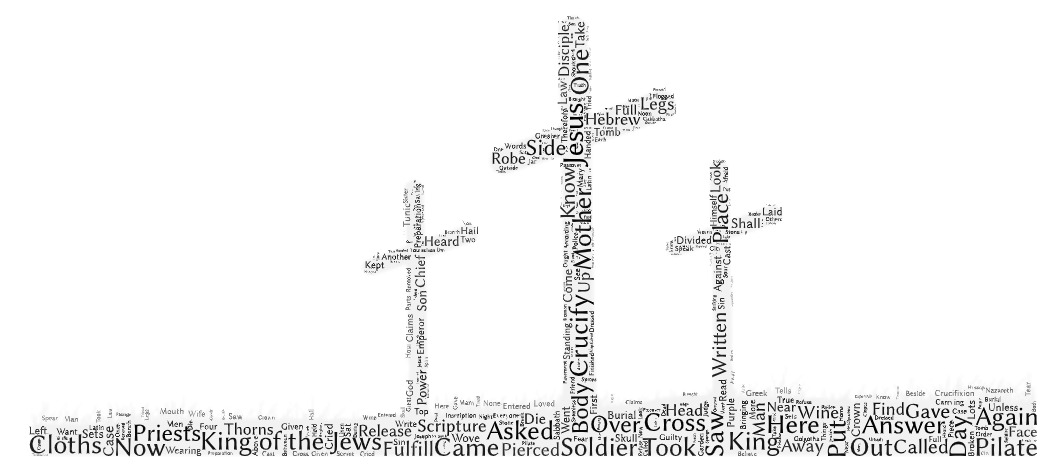
The top 12 words in the prayer are:

World

Given

One

Know

Sent

Word

Father

Glorify

Gave

Ask

Behalf

Love


My word counter (wordart.com) eliminates small connecting words like “in”, but this passage has a lot of the preposition “in” + pronoun:  in me, in you, in them, in us.  There is a lot of “being in.” 


At the start of this Chapter 17 prayer Jesus says: 

“Father, the hour has come; glorify your Son so that the Son may glorify you, since you have given him authority over all people, to give eternal life to all whom you have given him. 3 And this is eternal life, that they may know you, the only true God, and Jesus Christ whom you have sent.  I glorified you on earth by finishing the work that you gave me to do. So now, Father, glorify me in your own presence with the glory that I had in your presence before the world existed. (verses 17:1-5)


Lots of glorifying there.  Glorify means “to praise, extol, magnify, celebrate, honor.” (Strong’s Concordance)


In verses 1-5 which I quoted above, we see some of the themes from the opening words from Chapter 1:

In the beginning was the Word, and the Word was with God, and the Word was God.  He was in the beginning with God. All things came into being through him, and without him not one thing came into being. What has come into being in him was life, and the life was the light of all people. …. 

And the Word became flesh and lived among us, and we have seen his glory, … No one has ever seen God. It is God the only Son, who is close to the Father’s heart, who has made him known.

- Chapter 1, verses 1-4, 14, 18.


In his prayer Jesus also recalls the Logos (Word) of Chapter 1:

  • I have made your name known to those whom you gave me from the world. They were yours, and you gave them to me, and they have kept your word. (verse 6)

  • I have given them your word, and the world has hated them because they do not belong to the world, just as I do not belong to the world. (verse 14)

  • Sanctify them in the truth; your word is truth. (verse 17)

  • I ask not only on behalf of these, but also on behalf of those who will believe in me through their word,  that they may all be one. (verse 20-21a)

In each of these verses “word” is “logos” in Greek.  It can have so many layers of meaning in this prayer.


Jesus prays for protection from evil for his followers, present and future.  


Jesus ends his prayer with a request for God’s love to be in his followers:

 “Righteous Father, the world does not know you, but I know you; and these know that you have sent me. 26 I made your name known to them, and I will make it known, so that the love with which you have loved me may be in them, and I in them.” (verses 17: 25-26)


Jesus’ prayer includes many of the themes we’ve seen all along in this gospel, as you can probably tell from the list of the top 12 words (above).  The prayer is infused with a poetical sense of belonging, loyalty, unity.  It’s so poignant, juxtaposed with the upcoming separation that Jesus is facing.


In the next chapter Jesus will begin the painful and humiliating path to death on the cross.