Saturday, March 26, 2022

A Common Household Austen Odyssey


Without love, we are indeed toast.
American Visionary Art Museum
Baltimore, Maryland.  2016.

I am blessed beyond measure to be in two book clubs.  One is the Page Turners’ Book Club (started by a pianist).  This group, all women, picks all its books for the year at once, and makes a point of reading lit related to women during March, Women’s History Month.  For March, our pick was Pride and Prejudice, by Jane Austen.


The other book club was started by the Common Household Husband Himself in 2015.  This book club picks next month’s book at the end of each meeting.  After reading the well-written but anxiety-producing Innocent Blood by P.D. James for this book club in February,I was ready for a calmer read, and lobbied the CHH book club to take the leap back to the early 1800s and read Pride and Prejudice. The choice had plusses and minuses:  I would get to kill two reading assignment birds with one stone, but because I suggested the book, I therefore became the discussion leader.  


Late February

As I start in on P&P, I notice that the nearly-free e-book edition I got 10 years ago is rife with typos, and instead of italics, the emphasis is provided by using ALL CAPITALS.  This was acceptable to me in 2011 but is now intolerable to me in 2022.  


Wanting to get the Penguin publisher’s digital edition, I search for “Pride and Prejudice Penguin”, and get this as the top result:


Pride, Prejudice & Penguins: A More in Heaven and Earth Magical Academy Pride and Prejudice Variation, by Katherine Gilbert.
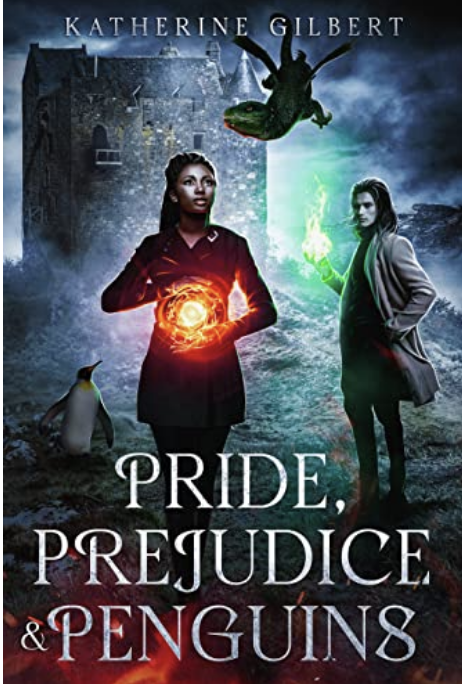

According to the Amazon blurb, it includes penguins, magic, a medieval castle on a Scottish island, an elf king, and possibly sarcastic talking cats, although it is unclear if sarcastic talking cats are included in this book, or only in other books by this author.


Early March

The Common Household Husband is partway through Vol. 1 of the original Pride and Prejudice; it is not to his liking. Perhaps he would prefer the one with the penguins & magic. 


At dinner, the CHH wonders aloud at possible P&P plot twists: “When will Mr. Darcy reveal that he prefers other men?  When will Mr. Blingley say that he planned all along to have a  mistress immediately after marrying?  When will one of the characters become destitute?  When will the owner of the estate own up to a gambling problem, such as investing in the shipping industry, and the ship goes down?”  


Apparently the plot is not swift enough for CHH, especially compared to the P.D. James psychological thriller from last month.



Whereas the CHH falls asleep at every third page, I am finding it to be wonderful escapism.  Austen writes about well-off people acting out their social game, with very important consequences, that is, the future economic well-being of the women characters. But no strife occurs other than bad manners and turning down marriage proposals.


During the time Jane Austen was writing (early 1800s), here are just a few things going on in the world:

  • slavery (Britain abolished slave trade in 1807 but did not abolish slavery until 1833)

  • Colonialism

  • Severe economic inequality

  • The Napoleonic wars

  • British Prime Minister Spencer Perceval assassinated (1812)

  • War of 1812 (US v. Britain) 


Jane Austen had plenty of opportunity to introduce strife into her novels, but chose instead to focus on one segment of English society. One reviewer points out that the reader gets to know the annual income of nearly every character in the novel.


Middle of March 

The Common Household Husband has read a little further through Vol. 1.  He says to me, accusingly, “Who is this new character - Mr. Wexford?!”

Me:  Wickham.

CHH:  He is not on good terms with Mr. Darcy.  And Mr. Blinky thinks that Mr. Darcy is not to blame.   Mr. Wickham is the vicar.

Me:  No.  Mr. Collins is the vicar.  Wickham was going to be a vicar… (I pause, not wanting to give away the plot).

CHH:  I think I should just find the movie version.  Is there a Russian musical version?

Me:  There are a lot of versions, both movies and other books.  There is “Pride and Prejudice and Zombies.”  

CHH:  How many of the characters are Jewish? 


I urge CHH not to give up yet, to read at least through the letter that Darcy hands to Elizabeth.


Six days later…

It’s a rainy Saturday morning, and I am trying to muster the energy to go collecting more petition signatures to get candidates on the ballot.  I’m working on my voter list. The Common Household Husband comes into the office and sits down behind me ominously.


After a minute or so of him lurking there, I figured out that he has something to tell me.  He says, “I finished reading Darcy’s letter to Elizabeth.  I have to say that it does not change my opinion of Darcy.”

Me:  So you still think he’s gay?

CHH:  No.  But I think he is quite respectable and has made good decisions.

Me:  So you are okay with his marriage proposal, where he said, “I’ll marry you even though you are low class compared to me, and your family engages in bad behavior”?

CHH:  Yes.  That seems perfectly reasonable to me.


Two days before book club meets

The Common Household Husband is now getting into the book. He says, “Lydia!  She has run off with Wickaby!  And Mrs. Bennet is only concerned about clothes.”


One day before book club meets

CHH has not yet finished the book, but gives me his latest on the plot synopsis and character assessment:


Lydia is going up north with Wickaby.   She doesn’t see that she did anything wrong.  Nothing happened in this book until Lydia ran off with him.  …  Elizabeth has learned the role that Mr Darcy played in preventing a scandal from Lydia and Wickaby’s behavior.  Mr Binkley is back at, um, Nutherfield, and I'm assuming it's because Mr Darcy has relented and told him it’s fine for him to marry Jane. Mr Bennet is most displeased with Lydia.  Because of her, he has told his youngest daughter she may not associate with anyone for the next ten years, and no one may go to Brighton, ever.  He continues to be the most ineffectual father and husband. 


Elisabeth Bennet may have changed her opinion of Mr Darcy, but the CHH’s opinion hasn’t shifted.  He thought Mr D was fine before and thinks he is fine now.  The CHH is in bitter disagreement with Younger Daughter, who thinks Mr Darcy is a terrible person who absolutely did not deserve to get redeemed or be with Elizabeth at the end.


One definition of a classic is perhaps “a book that people can’t stop talking about.”  Pride and Prejudice has definitely met that grade in the Common Household. We could argue for hours about whether Elizabeth Bennet is a feminist for her time because she insists on marrying for love, if Jane Bennet would have made a terrible main character, if Mr. Bennet is a loving father stuck in a bad financial situation or if he's irresponsible.


But it's time to start on next month's book.


Thursday, March 24, 2022

The Gospel of John, Chapter 10: Sheep


Read Chapter 10 here.


This chapter is a continuation of the point Jesus was trying to make in Chapter 9.   He had just told the Pharisees “If you were blind, you would not have sin. But now that you say, ‘We see,’ your sin remains.”


Now Jesus tries out a new metaphor.   Because so far his metaphors are really getting through to people. /s/  Except that only those who already believe Jesus is the Messiah will get the metaphors.  


Jesus’ new metaphor (verses 10:1-5), in bullet points:

  • Anyone who doesn’t go into the sheepfold by the gate, but climbs in another way, is a thief.

  • The shepherd enters by the gate.  No sneaking around.

  • The gatekeeper opens the gate for the shepherd, and the sheep hear the shepherd’s voice.

  • The shepherd calls the sheep by name, and leads them out into the pasture.

  • Once the sheep are all out, the shepherd goes ahead of the sheep, and the sheep follow the shepherd because they recognize the shepherd’s voice.  The sheep won’t follow a strange voice.


Well, it’s hopeless.  The Pharisees still don’t understand.  Again Jesus tries to explain (verses 7-10) with another of this gospel’s famous “I am” statements:

  • I am the gate for the sheep.  (or, I am the door.)

  • Everyone who came before me are thieves, but the sheep didn’t listen to them.

  • I am the gate (he says again).  Whoever enters by me will be saved, cared for, and can find pasture.

  • The thief only comes to steal, kill, destroy.

  • But I came so that they (the sheep) can have abundant life (eternal life).


Jesus muddles things up (on purpose?) by sticking with the sheep theme, but a different metaphor, with the fourth “I am” statement of the gospel:

“I am the good shepherd.  The good shepherd lays down his life for the sheep.” (v. 11)


Jesus continues: A hired hand doesn't really care about the sheep and if a wolf comes to attack, the hired hand will run away and leave the sheep unprotected.  He repeats for emphasis:

“I am the good shepherd.  I know my own and my own know me, just as the Father knows me and I know the Father.  And I lay down my life for the sheep.  I have other sheep that do not belong to this fold.  I must bring them also, and they will listen to my voice.  So there will be one flock, one shepherd.  For this reason the Father loves me, because I lay down my life in order to take it up again.”  (v 14-17)


I’m going to leave aside interpreting who are sheep of this fold and not of this fold.  Let’s just acknowledge that the notion of having a shepherd to lead you and guard you from harm and take you to your pasture for lunch and bring you back to the fold for sleepy time - that’s very comforting.  Jesus the shepherd is so dedicated that he is willing to give up his own life in order to save the sheep.  For those who know how the story ends, verse 17 is a reference to the crucifixion and resurrection.


But this metaphor also contains the same black-and-white thinking that runs through this gospel.  Either you go through Jesus-the-gate or you are a thief.  Either you are in the flock or you aren’t.  


Jesus also touches on another theme we’ve seen before - his authority.  When Jesus refers to himself as the good shepherd, he is probably alluding to Psalm 23, “The Lord is my shepherd.”  Once again Jesus is claiming equality with God.  In verse 17-18 he says:

“... because I lay down my life in order to take it up again.  No one takes it from me, but I lay it down of my own accord.  I have power to lay it down, and I have power to take it up again.  I have received this command from my Father.”


In biblical language, shepherds are definitely leaders, and God is the Shepherd par excellence.I didn’t remember that this metaphor was elsewhere in the Bible (other than this gospel) until Sunday when I saw one of our scripture passages was from Ezekiel 34.  In the Ezekiel chapter, there are false shepherds, and then there is God, the ultimate shepherd and judge.  


Not for the first time, Jesus’ claims cause division among “the Jews.”  Some say he has a demon, but others say demons don’t heal blindness, so Jesus can’t be a demon.  


It’s now winter, and time for the festival of Dedication, which is the celebration of when the Maccabees rededicated the Temple in Jerusalem, after it had been desecrated by King Antiochus.  In other words, it is Hanukkah.  But back then they probably did not have a Hanukkah bush, or give presents for eight days, or get Latke Larry out of the attic, or sing “I Have a Little Dreidel.”  I don’t know how Hanukkah was celebrated at that time.  


The thing that drove me nuts about Latke Larry is that Jerry Stiller could not carry a tune. It was a cute song, but couldn’t they get someone who could sing?


Anyway, Jesus is walking around in the temple.  “The Jews” pester him again asking if he is the Messiah.  “Tell us plainly,” they say.   Jesus says, “I already told you.”  Well, he told them in a lot of metaphors and oblique speech, but he didn’t tell them plainly.  Jesus repeats sentences we’ve read in previous chapters, about doing work in the Father’s name.  But this time he connects his accusations to his sheepfold metaphor: “you do not believe because you do not belong to my sheep.”  


Once again he makes a daring statement equating himself with God:  “What my Father has given me is greater than all else, and no one can snatch it out of the Father’s hand.  The Father and I are one.”


The Jews threaten to stone him for blasphemy (as they did in Chapter 8).  Jesus quotes scripture back at them.  For the umpteenth time he refers to the works he is doing, which are, in fact, the “works of my Father.”  


They try to arrest him, but he escapes.  He goes across the Jordan River to where John was baptizing back in Chapter 3.  The crowds come and people believe in Jesus (align with him, are  loyal to him).


Metaphors: sheepfold, gate, shepherd, sheep


Images and themes: Jesus as the only path to life abundant.  Death.  Blasphemy.  And all the themes of the past chapters, too:  working/works of God, Jesus equating himself with God, belief, judgment, resurrection, Messiah, antagonism with authorities, blindness. 


People/Beings:   Jesus, the Pharisees, “The Jews”, many people.


Places: Jerusalem, at the Temple (the portico of Solomon), across the Jordan River.


Wednesday, March 16, 2022

The Gospel of John, Chapter 9: Blindness


 Read Chapter 9 here.


This is a fascinating chapter with a difficult lesson.

After narrowly escaping being stoned to death, Jesus is walking along somewhere.  He sees a man who has been blind from birth.  The disciples want to know if the cause of the blindness is the man’s sin or his parents’ sin.  Jesus says, nope, neither one; he’s blind so that “the works of God might be displayed in him.”  (This could lead into a deep discussion of theodicy, but I’m not going there - too tired.)   

And then Jesus lapses into metaphor again: day, night, I am the light. “As long as it is day, we must do the works of him who sent me.  Night is coming when no one can work.” (verse 4).  So the themes of light and work(s) continue.

Jesus makes a paste of mud with his spit, puts the paste on the blind man’s eyes, and tells him to wash in the pool of Siloam. When the man does this, he can see.  

The neighbors have a dispute on who this now-seeing person is.  They bring the man to the Pharisees.  Uh oh, this is sure to mean trouble for Jesus.  The Pharisees decide that Jesus’ healing the man on the Sabbath breaks the laws of the Sabbath.  It probably has something to do with touching mud?  Or spit?  Or it’s a false accusation?  Not sure.  

The Pharisees still doubt the man’s story, so they send for his parents, who are afraid to tell the truth.  They know the Pharisees will expel from the synagogue anyone who says Jesus is Messiah.  The Pharisees question the man a second time which understandably makes him testy.  The Pharisees get testy right back, and insult the formerly blind man.

The man finds his voice to stand up to authority.  He says to the Pharisees, 31-33 “... We know that God does not listen to sinners.* He listens to the godly person who does his will. Nobody has ever heard of opening the eyes of a man born blind. If this man were not from God, he could do nothing.”

*An aside - many of us would say that God does listen to sinners.  Note that this is the formerly blind man speaking, not Jesus and not the gospel author.  But perhaps the point here is that the Pharisees, as portrayed in this gospel, are not going to claim so.

The Pharisees, who clearly think that Jesus is not from God, feel threatened by this man’s challenge to their authority.  They taunt him:  “You were steeped in sin at birth; how dare you lecture us!” (verse 34).  This contradicts Jesus’ declaration in verse 3 that neither the man’s sin nor his parents’ sin caused the blindness.  The Pharisees throw the man out, presumably out of the synagogue.

Hearing that the man has been expelled, Jesus finds him.  He asks the man, “Do you believe in the Son of Man?”  The man replies, who is that?  Jesus, in typical fashion for this gospel, replies by referring to himself in the third person:

“You have now seen him; in fact, he is the one speaking with you.” (verse 37)

The man professes belief in Jesus (aligns with him, is loyal to him, beloves what Jesus beloves) and bows down to him.  

Then Jesus, fulfilling his prediction in verse 3 that the works of God would be displayed through this blind man, says, “For judgment I have come into this world, so that the blind will see and those who see will become blind.” (verse 39)  Does this statement conflict with verse 3:17?

A review of judgment and condemnation so far in this gospel:  

  • In 3:17 the gospel writer said “For God did not send his Son into the world to condemn (judge) the world, but to save the world through him.” 
  • In 5:22-27 Jesus said that The Father has given all judgment to the Son. 
  • And in 5:30 Jesus said “my judgment is just, because I seek to do … the will of him who sent me. 
  • In 7:24 Jesus urged The Jews to not judge by appearances, but “judge with right judgment.”   
  • In 8:1-11 the woman caught in adultery has been condemned to death, but Jesus said only those who can claim to be without sin can inflict her punishment, and in the end, no one was left to condemn the woman.
  • In 8:15-16, Jesus said he judges no one and then backtracked and said he judges with the Father who sent him. 
  • In 9:39, Jesus said, “I came into this world for judgment so that those who do not see may see, and those who do see may become blind.” 

So is it 3:17 (not to condemn the world) or 9:39 (for judgment)? In these past few chapters, Jesus seems to be more about judgment, at least of the religious authorities, than he is about saving. 

The Pharisees are sort of like the Keystone Cops, and haplessly say, Who us?  “Surely we are not blind, are we?”  

Jesus’ reply is fascinating to me.  

41 Jesus said to them, “If you were blind, you would not have sin. But now that you say,

‘We see,’ your sin remains.

He seems to be saying that the Pharisees’ claim to “see” is what makes them sinful. All along in this gospel Jesus has chastised those who don’t understand his metaphors, with the Pharisees chief among those he disses. I think he is compelling the Pharisees to “become blind”, that is, to stop thinking they have all the right answers and try to experience the world from another perspective.

If I can get past all the polemical accusations against the Pharisees, and their portrayal as unabashedly evil,  this is a most interesting chapter.  Who among us can really see everything and has all the facts to justly judge a situation or another person?  

Coming up in Chapter 10, Jesus is about to throw at them a brand new metaphor.  Who will see and understand?


Metaphors: blindness, light, 
Images and themes: judgment, belief, work
People/Beings:   a blind man, the disciples, Jesus, the blind man’s neighbors and parents, the Pharisees.
Places: Walking along (somewhere in Jerusalem)

Saturday, March 12, 2022

First lines: February 2022 edition


Below are the first lines of the books I finished reading in February.  Only 4 books, because I had to spend time agonizing about democracy, and my work hours increased dramatically.


Book 1

Toward the end of September 1579, a letter arrived in London addressed to Queen Elizabeth I of England.  Wrapped in a satin bag and fastened with a silver capsule, the letter was an object of exquisite beauty, unlike any other diplomatic correspondence the queen had ever received.


Book 2

 Timeline of Key Events in US Voting History

1773 Boston Tea Party

1775 Beginning of the American Revolutionary War

1776 Declaration of Independence


Book 3

Part I: The Lost Twins (1968)

The morning one of the lost twins returned to Mallard, Lou LeBon ran to the diner to break the news, and even now, many years later, everyone remembers the shock of sweaty Lou pushing through the glass doors, chest heaving, neckline darkened with his own effort.


Book 4

The social worker was older than she had expected; perhaps the nameless official who arranged these matters thought that graying hair and menopausal plumpness might induce confidence in the adopted adults who came for their compulsory counseling.


The titles and authors revealed:


Book 1

The Sultan and the Queen: The Untold Story of Elizabeth and Islam.  By Jerry Brotton.  Published 2016.  354 pages.

This book unexpectedly contained plenty of Shakespeare.  The main things I learned from this book are that 1) there was a gigantic battle called The Battle of Alcácer Quibir, and 2) if it weren’t for the poor military decisions by the overly cocky King of Portugal, we might all be speaking Portuguese today.


Book 2

Drawing the Vote: An Illustrated Guide to Voting in America,  by Tommy Jenkins, illustrated by Kati Lacker.  Published 2020.  190 pages.  Graphic book.  

I didn’t like this book. Maybe the topic does not lend itself to the graphic book genre.  I wasn’t thrilled with the illustrations.


Book 3

The Vanishing Half, by Brit Bennett, published 2020.  352 pages.

A novel examining what makes a person herself, or himself.  Which parts of oneself can one escape? The writing is excellent and the characters are memorable.  I read it for book club, but then sadly was not able to attend the discussion.  


Book 4

Innocent Blood, by P.D. James.  Published 1980.  409 pages.

This is a story about people surrounding a singularly horrible event – the rape and murder of a child.  Most of the characters are borderline sociopaths.   Very good writing, with attention to detail, including descriptions of flowers.  I read it for the other book club.


Valiant effort but did not finish The Cartoon Guide to Biology.  by Larry Gonick and David Wessner.  2019.  320 pages.  Graphic book.

Biology, my eye.  It was all chemistry.  But the pouty cavewoman at the beginning of the book did warn me that biology ain’t what it used to be - biology these days doesn’t start with study of living creatures, but rather from the molecular parts that make up the living creatures.  The illustrations were great, and included much personification of molecules.  For a brief moment, I had an understanding of how a cell membrane is formed, but I have forgotten because, you know, world mayhem started on Feb 24th.  I got about halfway through before giving up.  I will remain content to be the wife and mother of biologists, without furthering my understanding of their field.


Friday, March 11, 2022

The Gospel of John, Chapter 8: To Throw the Stone


The Gospel of John, Chapter 8  - To Throw the Stone


Read Chapter 8 here.


Jesus says some extremely provocative things in this chapter, and it’s a long chapter.  Basically it’s a big argument between Jesus and the Jewish authorities.


The first 11 verses of this chapter are in brackets, because some ancient manuscripts of the Bible don’t include it.  This section is often called “The Woman Caught in Adultery” but The Message more appropriately calls it “To Throw the Stone”, which puts the emphasis where it should be.


It’s the morning after the events of Chapter 7.  Jesus apparently spent overnight at the Mount of Olives, but returns to the temple the next day, and does some teaching.  The scribes and Pharisees want to trick Jesus so that they can arrest him.  They bring before Jesus a woman who was caught committing adultery, and try to get Jesus to contradict what the law says her punishment should be - death by stoning.  Jesus ignores them, doodling in the dirt while they prattle on. Finally, Jesus famously says, “Let anyone among you who is without sin be the first to throw a stone at her.”  Gotcha!  Now if one of ‘em throws a stone at the woman, it’s the equivalent of claiming “I’m sinless!”  The scribes and Pharisees all slink away.


Remember who is entitled to throw the first stone, O Best Beloved.


Jesus tells the woman that he hasn’t condemned her, and neither has anyone else.  He advises her to go on her way, and to not sin again.  So it’s not that the woman did no wrong.  It’s that she is not going to be accused or have to bear punishment.  (verse 11)


And now, another of the “I am” statements of this gospel:

12 Again Jesus spoke to them, saying, “I am the light of the world.  Whoever follows me will never walk in darkness but will have the light of life.”

A beautiful statement, referring to the creation story and the poem at the start of this gospel:

John 1:4-5 In him was life, and that life was the light of all mankind. The light shines in the darkness, and the darkness has not overcome it.


The Pharisees question Jesus’ authority to say such a bold thing.  He says that his testimony comes from “the Father who sent me” and further accuses the Pharisees of not knowing God.


Jesus tells the Pharisees, “I am going away” which is a euphemism for death.  Jesus says “You are from below, I am from above; you are of this world, I am not of this world.” (verse 21)  More provocatively, he tells them in verse 24 that  “you will die in your sins unless you believe that I am he.”


He who?  The Pharisees understandably ask “Who are you?”  Ah, that’s the crux of it.  So far Jesus has said, “I am the light of the world… I judge no one…” (and immediately contradicting himself) “my judgment is valid.”  He’s like the guy in the beer commercial:  I judge no one, but if I do, I judge not alone but with the Father who sent me.  


However, I don’t think the Pharisees are asking that question with genuine curiosity.  This gospel has already said that the authorities are looking to trip up Jesus so they can arrest him and kill him.


But in response to their question Jesus responds with a snippy “Why do I speak to you at all?”   Eventually he says “When you have lifted up the Son of Man, then you will realize that I am he…”   “The Son of Man” is most likely another term for “Messiah” - the anointed one.


Some of the Jews hear what he is saying and believe in him. Remember that from Chapter 6 we could interpret “believe in him” to mean that these people decided to align with Jesus, to be loyal to Jesus.  They decided to “belove God and all that God beloves.”  Jesus says (verse 31):  

“If you continue in my word, you are truly my disciples; and you will know the truth and the truth will make you free.”

The text doesn’t explain what he means by “continue in my word.” The CEV translation says “If you keep on obeying what I have said, you are truly my disciples.”  As far as I can tell, what Jesus has said is: Believe in me.  I am from God. Follow me.  Come to me.


The new believers don’t ask what “continue in my word” means. Instead, they object that they have never been slaves.  They are Jews, so they say “we are descendants of Abraham.”  Jesus replies, well, you kinda have been slaves because  “everyone who commits sin is a slave to sin” (verse 34).  Remember, O Best Beloved, who can throw the first stone, from verses 8:1-11.   Jesus says to them, “Because I tell the truth, you do not believe me.  Which of you convicts me of sin?” (verse 45-46).  He is supposedly talking to the new believers but Jesus does not view them as believers in him; in his view they have not aligned with him.


The whole exchange descends into a horrible argument.  This section could easily be used for anti-Jewish purposes.  Jesus says to them, you are trying to kill me, and you don’t know God.  In fact, you are children of the devil.  Accusatory words!


Not surprisingly, they try to stone him, but he hides and escapes.


So this gospel’s antagonism between the Jews and Jesus continues.  The emphasis on belief in Jesus continues.  But we have received a gem of wisdom: no person is entitled to throw the first stone to punish another’s sin.  That’s what Jesus said, but just try and find anybody who lives by that maxim these days.


Metaphors: the light of the world, darkness, slavery.

Images and themes: no one is without sin, Jesus offers light and life, the authority of Jesus’ testimony, the

blindness of the Jews (the portrayal seems horribly antisemitic to me).

People/Beings:   Jesus, the people, scribes and Pharisees, a woman caught in adultery,

“The Jews”

Places: in Jerusalem: on a spot of dirt at the temple, then in the temple “Treasury” 


Friday, March 4, 2022

The Gospel of John, Chapter 7: Not Yet Time


The Gospel of John, Chapter 7:  Not Yet Time


Read Chapter 7 here.


After that big argument with the authorities about eating flesh and drinking blood, Jesus decides he is better off staying in Galilee, away from Judea, because “the Jews were looking for an opportunity to kill him.”  


The Jewish festival of Sukkoth is approaching.  Jesus’ brothers encourage him to go to Judea so he can be more widely known.  The text says in verse 5 “(For not even his brothers believed in him.)”  Jesus says, my time has not yet come, the world hates me; you go on to Judea but I’m staying here in Galilee.  


Except (!) Jesus sneaks into Judea anyway!  


Some in the crowds are complaining about Jesus (verse 12).  Jesus goes to the temple (i.e. in Jerusalem, which is in Judea) and begins teaching.  This astonishes The Jews, but Jesus says, it’s not my teaching but the teaching of the one who sent me.  He accuses them of not keeping the law of Moses (quite daring!).  And asks why are you looking for a chance to kill me?  The crowd says “You have a demon!  Who is trying to kill you?” (verse 20) 


Apparently the issue still is that Jesus healed someone on the sabbath.


Jesus says “the one who sent me” a lot in this gospel.  He spends a lot of his time insisting that he is not speaking of his own accord, but speaking on behalf of God.  He also speaks of himself  in the third person.  Clearly, the authority of Jesus is a main theme of this gospel.


People in Jerusalem begin asking, is this the Messiah?  


The Pharisees and chief priests send police to arrest Jesus (verse 32).  But the police don’t carry out their orders, because “his hour had not yet come.”  Jesus speaks metaphorically, “I am going to him who sent me.  You will search for me but you will not find me…”  The Jews take his statement literally - is he saying he is going to teach the Greeks?


On the last day of the festival, Jesus again refers to himself as living water.  His declaration causes some in the crowd to believe he is the Messiah, but others say that the Messiah couldn't possibly come from Galilee. (verses 41-43)  


The police have not arrested Jesus, because he speaks in a way no one else ever has.  The Pharisees are incensed and accuse the police of being duped by Jesus.  They present themselves as having the appropriate judgment and they say the crowd doesn’t know the law the way the Pharisees do.  The crowd are “accursed” (ignorant, guilty, damned).  Again the polemic nature of the gospel shows.


The Pharisee Nicodemus (who back in Chapter 3 had gone to see Jesus), speaks up for Jesus, saying he deserves a hearing.  The rest of the Pharisees mock Nicodemus, saying, don’t you know there is no prophet to come from Galilee?


The insults are really flying in this chapter. and there is an ominous tone, a sense of foreboding.  


Metaphors:  thirst, water

Images and themes: Jesus teaches ‘from God’, failing to arrest Jesus, 

People/Beings:   Jesus, his [unbelieving] brothers, “The Jews”, the crowds, some of the people of Jerusalem, the Pharisees, the temple police, Nicodemus.

Places: Galilee, the Festival of Booths in Jerusalem, the temple.