Friday, January 28, 2022

The Gospel of John, Chapter 3: God loves the universe

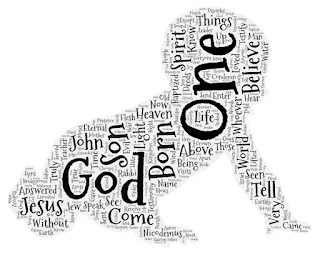
This is supposed to be a baby.
But maybe it just looks like a creepy blob.

The Gospel of John, Chapter 3


Read Chapter 3 here.


Nicodemus, a Jewish leader, comes to Jesus at night.  N. recognizes that Jesus is from God, because of the signs Jesus is doing.  Jesus says that to see the kingdom of God a person must be born anew, or born from above. He uses birth as a metaphor for spiritual renewal.  N. doesn’t get it.  


Then Jesus pushes further, talking about not just seeing but entering the kingdom of God, which must be obvious what it is, because it is not defined.  Only those who are “born of water and Spirit” can enter the kingdom of God.  Jesus says to N., you just do not understand.


Speaking in the plural, Jesus says, we are testifying to what we have seen, but you all reject our testimony. But the way the scene was set, I had assumed Jesus was alone with Nicodemus.  Whom is he accusing of rejecting his testimony?  


Then, Jesus utters these famous words:


John 3:16 “For God so loved the world that he gave his only Son, so that everyone who believes in him may not perish but may have eternal life.”


But for me, it’s the next verse that is more important:  “God did not send the Son into the world to condemn the world, but in order that the world might be saved through him.” 


3:17  οὐ γὰρ ἀπέστειλεν ὁ θεὸς τὸν υἱὸν εἰς τὸν κόσμον ἵνα κρίνῃ τὸν κόσμον ἀλλ᾽ ἵνα σωθῇ ὁ κόσμος δι᾽ αὐτοῦ


In the Greek, the word translated as “world” is “kosmos”; the word translated as “condemn” is “krino” = “judge”.


But then the author of the gospel again goes for the antagonistic dichotomy - those who believe are saved; those who don’t believe are already condemned.  Light vs. dark.  The language here does not make mention of second chances.  It does talk about evil deeds, which is a shift from the language of belief to something more concrete, but still not very well defined.


3:19-20 And this is the judgment, that the light has come into the world, and people loved darkness rather than light because their deeds were evil.  For all who do evil hate the light and do not come to the light, so that their deeds may not be exposed. 


Then Jesus & Co. go to Judea.  Both Jesus and John the Baptist are there baptizing folks.   John the B. says, again, that he himself is not the Messiah.  He speaks of the Messiah in the metaphor of a bridegroom.


The last paragraph of the chapter is not speech attributed to anyone.  It’s more a mini-sermon about those who accept Jesus’ testimony vs. those who don’t.  Heaven vs. earth.


Metaphors: birth, wind, bridegroom, light, darkness.

Images and themes: being born from above, baptism, Messiah

People/Beings: Nicodemus, Jesus, God, the disciples, John the Baptist, “A Jew”

Places:  Jerusalem, the Judean countryside.


Sunday, January 23, 2022

The Wisdom of the Common Household Husband

Not a live moose


Last year was a challenging year, but the Common Household Husband helped steer our ship of household on a reasonable path.  Here is some of his wisdom that helped get us through.


January

Younger Daughter helped herself to a chocolate covered almond, even though she doesn’t like almonds.

Me:  You’re not going to waste that almond, are you?

CHH:  Yeah. Almonds don’t go on trees, you know.


February

The CHH made himself a cup of French Vanilla tea.  Then he poured Peach Schnapps into it.  I said, “I am predicting that is not a good taste combination.”  

He tasted it, and said, “Hmmm.  It’s like wearing a plaid shirt with rainbow suspenders.”


March

I was making the roasted egg for the seder plate.  

Me: How long should I roast the egg?  Twenty minutes?

CHH: Yeah, that’s right.  That’s how long it took to cross the Red Sea.  


April

We were discussing brands of grape juice, as a Jewish-Christian household is likely to do.

CHH:  I prefer Bernoulli’s Grape Juice.

Me:  Is that some kind of physics joke?  I don’t get it.  But if you had said you prefer Schrödinger’s Grape Juice, I would understand.

CHH:  I was looking for Schrödinger’s Grape Juice, but I couldn’t find it.  I asked where it was, and some people said it was in that aisle, and some people said it wasn’t in that aisle.

But Bernoulli’s Grape Juice – that wakes me up in the morning!

Me: (reads about Bernoulli’s principle on Wikipedia; looks perplexed.)  Let’s see.  There’s the Bernoulli distribution. – that’s not it.  How about, “What is Bernoulli’s principle in simple terms?”  It says “In fluid dynamics, Bernoulli's principle states that an increase in the speed of a fluid occurs simultaneously with a decrease in static pressure…”

CHH:  Doesn’t that apply to grape juice?


May-August

(Apparently we were not paying attention during the summer, perhaps because we actually did some traveling and moved our younger daughter twice.)


September

CHH told me, "The rabbi called to wish me gud yontif." Then he explained further, "Yontif is Jewish for yom tov."


October

At dinner, we were talking about how and when to celebrate all the upcoming holidays. I looked at the calendar and said, “Christmas is on a Saturday.”

Son:  Is there a special prayer for when shabbat falls on Christmas?

Me:  Dad is talking about going “hunting” on Christmas.

Son: When has Dad EVER gone hunting?!

CHH:  It’s a euphemism for Las Vegas.   Speaking of hunting, I met a guy at the casino today who said he went hunting and shot a moose.

Me, reading facts about moose, to try and find out if they are endangered: Moose grow to be six foot nine inches tall.

CHH: Joseph Conrad was 6 and a half feet tall.

Me: That’s an odd factoid to know about Joseph Conrad.

CHH:  Well, he looks really tall.

Me: : Joseph Conrad, the author of Heart of Darkness?!

CHH:  No, the guy who stars on The Rifleman.

Me:  Do you mean Chuck Connors?


(For the record, Chuck Connors was 6 ft 5 inches tall.  The internet does not know how tall Joseph Conrad was.  Apparently moose, at least the Northwestern Moose, are not considered endangered.  Also for the record, the CHH did not get to go hunting or to Las Vegas.  He regrets the latter.  )


November

CHH, complaining that the news is always the same:  “Every day Congress is subpoenie-weenying, and nothing ever happens.”


CHH, talking about the true history of the Exodus:  The manna was actually 9 egg sponge cake.  And after they ate it, someone said, ‘My mother’s was better.’


CHH’s suggestions for sequels to Man’s Search for Meaning by Viktor Frankl:

Man's Search for a Comfortable Chair.

Man's Search for Cream Cheese


(If he had read Man’s Search for Meaning he would not be making light of it.  Or maybe he still would, because of the way 2020-2021 has messed with our brains.)


December

Me:  Can we splurge and get new bathroom rugs?

CHH:   Why?!  This is the first I’ve heard of this idea.

Me:  I’ve been thinking about it for a long time.  Our rugs are old and probably harbor a lot of germs.

CHH:  All I want is a heated toilet seat with Bluetooth technology in it.


And that’s a good dream to enter 2022 with.


Saturday, January 22, 2022

The Gospel of John, Chapter 2: Water into wine, and smashing corruption


The Gospel of John, Chapter 2

(Read Chapter 2 here.)

The first miracle which Jesus performs in this gospel is changing water into wine at a wedding. The author calls it “the first of his signs”. In the other gospels, the first miracles are healings.  The end result of changing the water into wine is that Jesus’ glory is revealed, and the disciples believe in Jesus.

The Wedding at Cana story shows us that Jesus and the disciples went to parties, that Jesus hung out with his mom, and that Jesus makes the best wine out of water.  But Jesus seems detached from the party guests.  Maybe he is an introvert who is depleted of energy by being around a lot of people.

Then it is Passover, and Jesus & Co. go to Jerusalem, where Jesus drives out the merchants and moneychangers from the temple.  He takes a stand against the corruption of people whom I imagine are quite powerful. The disciples are perhaps watching but not participating - it isn’t clear. I’m going to assume that in this scene Jesus is a one-man riot machine, smashing the windows of the shops and throwing merchandise around.  He really messes stuff up - pouring out the coins all over the place and upturning the tables.  It’s a righteous action to call out such profit-making on the very grounds of the temple.  

But this action does not endear Jesus to the authorities.  “The Jews” (this term in this gospel disturbs me) ask Jesus to justify his riot.  Jesus speaks of the temple as a metaphor for himself, foretelling his death and resurrection, but they don’t understand.  

The author tells us that because of the signs that Jesus is doing, many “believed in his name”.  

Jesus seems aloof in this gospel, so far. He is not acting all good-shepherdy.  But he is challenging the powers that be.  That is probably comforting to a religious sect that feels beleaguered by powerful authorities.

The author continues to portray Jesus as omniscient.  Verse 2:24-25 says “But Jesus on his part would not entrust himself to them, because he knew all people and needed no one to testify about anyone; for he himself knew what was in everyone.” This is a verse I do not recall hearing often in worship. 

Metaphors:  Raising up a new temple in 3 days represents Jesus’ resurrection.  The wine might also be a metaphor.

Images & themes:  water, wine, antagonism with authorities

People: Jesus, his Mom, the disciples, the people at a wedding party,  Jesus’ brothers, merchants and moneychangers at the temple in Jerusalem, “The Jews”, believers. 

Places:  Cana, Capernaum - towns in Galilee; Jerusalem.


Saturday, January 15, 2022

Reading the Gospel of John


Periodically I undertake to read a whole book of the Bible.  Not the whole Bible, mind you, just a book.  I have never been able to do those projects of reading the whole Bible in a year; I am weak and a sinner, for sure.  I’ve tried, but get stuck in Leviticus, like most of the world.


Reading a whole book of the Bible, rather than in snippets the way scripture is delivered to us in church on Sunday, gives a better sense of the message and flavor of that book.  Last year I read 1 Samuel, because it seemed to pertain to political leadership, although it ended up just to be a tragedy. In 2020 I read Ruth, because we suddenly needed a topic for a retreat.  As books of the Bible go, Ruth is a great read - it’s a romance, without an awful lot of accusatory prophecy, and has very little smiting or battles with Jebusites.  


Now seems as good a time as any for me to undertake a reading of the Gospel of John.  It’s my least favorite of the four canonical gospels.  More than the synoptic gospels, the language in John is often a puzzle to me, and I find it also to be strongly anti-Jewish.  I don’t relate as well to the portrayal of Jesus as I do for the other three gospels. We’ll see how far I get.


Here are my observations for Chapter 1.

The Gospel of John, Chapter 1


The gospel begins with the famous poem “in the beginning was the Word”.  


ἐν ἀρχῇ ἦν ὁ λόγος καὶ ὁ λόγος ἦν πρὸς τὸν θεόν καὶ θεὸς ἦν ὁ λόγος


In the beginning was the Word, and the Word was with God, and the Word was God.


(No, I can’t really read Greek, but I think it looks lovely.)


We are immediately confronted with the concept of the “Logos”, the “Word”.  Book lovers should love this - word!  This Logos (a very full word) was there at the start of all creation, and is synonymous with God, the gospel writer tells us.  


The major metaphors so far:  Word, light, children of God, born.  The major concepts so far: life, testifying, grace, truth, and belief.  Verse 5 is a verse of unadulterated hope, and one of my favorites:


The light shines in the darkness, and the darkness did not overcome it.  


The weary world rejoices, for yonder breaks a new and glorious morn.  


The start of the gospel is a reiteration of the creation story, in a very John-ish sort of way.  The writer uses simple, short words, but each of those words is so loaded that the sentences carry huge meaning, or alternately, the meaning is obscured.


But already in verse 10-13, antagonism and division is introduced.  The world is split into two: those who accept the Word and those who don’t. It’s a very black-and-white view of things, which perhaps reflects that the writer was part of a community feeling threatened. At Christmas-time when we read these initial verses of John, we usually skip over these verses and go straight to the “full of grace and truth” in verse 14.


In verses 19-42, John the Baptizer appears on the scene, confronted by questioners sent by “the Jews.”  John the B says he is not the Messiah.  


More metaphor:  John the B. notices Jesus, calling him “the Lamb of God” and “the Son of God.”  


John the B. is responsible for introducing the disciples to Jesus.  Then Jesus heads for Galilee, collecting more disciples along the way.   


Chapter 2 Commentary


Friday, December 31, 2021

Favorite books read in 2021


Dear reader, what books did you read this year that you really enjoyed or found most meaningful? Which books had really great writing?


Books I read this year which I rated “excellent”.


Excellent Non-fiction

Stitches: A Memoir, by David Small (graphic memoir)  © 2009.  329 pages.

Do not read the liner notes unless you love spoilers!  Do not even look!

This book was quite moving and excellent.  Adult themes. 


Eleanor by David Michaelis,  © 2020.  536 pages of text. Including footnotes & index: 698 pages.

A biography of Eleanor Roosevelt.  The author tells the story of this amazing woman in an engaging way.  I still think about her house with the moveable walls.


I had time to read this book, which was given to me following the Nov 2020 election, because we did not go anywhere at Christmas-New Year's. A little bit of a benefit in the midst of the pandemic taking things away.


Excellent Fiction: 

Their Eyes Were Watching God, by Zora Neale Hurston. © 1937.  219 pages.

The dialect is hard for modern readers, but to me it’s important that the main character tell the story in her own way. This is the first (only?) novel I recall reading in which there is an independent town populated and run entirely by people of color. 


Long Bright River by Liz Moore.  © 2020.  492 pages

Excellent plot, compelling characters.  


Hamnet, by Maggie O’Farrell.  © 2020.  384 pages.

I made it about half-way through, but did not finish this book.  I am including it here because it has truly excellent writing and characters.  I could not handle the subject matter.


The Night Watchman by Louise Erdrich.  464 pages.  © 2020.  (Pulitzer prize winner)
Ghosts of the past which should haunt us. I read it on the recommendation of M.W.


And some others I enjoyed quite a lot:


The Boy in the Field, by Margot Livesey. © 2020.  268 pages. Fiction.


Moon Over Manifest, by Clare Vanderpool (children’s lit).  Published 2011. 365 pages. Fiction.


Letters from Father Christmas, by J.R.R. Tolkien.  Published 1976.  Letters originally written 1920-1943.  128 pages (many drawings).  Fiction.


The Rope: A True Story of Murder, Heroism, and the Dawn of the NAACP , by Alex Tresniowski.  © 2021.   335 pages. Non-fiction.


Begin Again: James Baldwin's America and Its Urgent Lessons for Our Own, by Eddie S. Glaude Jr.  © 2020.   272 pages. Non-fiction.


Being Mortal: Medicine and What Matters in the End by Atul Gawande. © 2014.  257 pages. Non-fiction.


Second readings:

Can’t We Talk About Something More Pleasant?  By Roz Chast.  Graphic memoir.  


Eleanor Oliphant is Completely Fine by Gail Honeyman.  © 2017.  331 pages.   


The Cross and the Lynching Tree, by James Cone.  © 2011. 158 pages.


Stats

In 2021 I finished 62 books, of which:

10 were children/YA books

1 play

1 legislative bill (I do not recommend)

1 book of the Bible


35 fiction, 27 non-fiction. Plus 1 selection of poems.

The Heights They Are Wuthering

About Wuthering Heights, by Emily Brontë


One-sentence summaries of the book:

This is a story of upper class people living on the Yorkshire moors who gaslight each other to death, as told through 3-4 narrators of unknown reliability.


The sins of the fathers are visited upon the children, who are all named after previous characters, just to confuse the reader.


If left to their own devices, upper class people will be utterly horrible to each other, leading us to draw the conclusion that without the servant class we cannot have civilization.


This book is Lord of the Flies on the Yorkshire moors.


As we read this book, we feel better about ourselves for at least not being as contemptibly horrible to those around us as the characters in the book are.


The moral of the story is:

Revenge is a dish best served cold, but don’t be too long about getting revenge because you will lose interest in it.


If you are going to be awful to your relatives, make sure that the servants are not listening.


Check the weather forecast before going walking about on the Yorkshire moors.


Write your will early on in your life, so that your sister and not your brother-in-law inherits your estate.


My wuthering thoughts

I am worried that I have read an abridged version of this book - printed books say 280-380 pages, but my kindle version (which does not say “abridged” or “unabridged”) had only 119 pages.  But maybe the printed versions are full of commentary and footnotes. 


This is a book mainly about revenge.  It is also about obsession, enmeshment, gaslighting, psychological abuse, physical abuse, and other utterly toxic relationship behaviors.  It’s bizarre to me that anyone could think the novel is about romantic love.  There is no healthy love portrayed here. It makes me wonder what kind of family the Brontes were, behind closed doors, outside of the public eye.


All the characters have such deep flaws that the reader is unable to sympathize with any of them. Usually I give up on such novels, but for some reason I was compelled to finish the book.


The novel might be about racism, but doesn’t treat it head on. 


When I read this book in my youth, I did not like it.  It seemed to just be full of a few people becoming ridiculously overwrought, with lots of sobbing, in a lonely place.  It still is, but there is much more there - this time I noticed the revenge, class, and race themes.  I also noticed the narrative technique.


What was Emily Bronte trying to say?

Taken at face value, Wuthering Heights seems to say that left to their own devices (on the Yorkshire moors), family members are bound to be nasty to each other.  Given the abuse the characters dish out, the ending seems falsely optimistic.  There is no way that people raised in such a toxic environment can end up having a healthy relationship unless they get a lot of psychological counseling.  


Is it a book against the notion that different classes and races can get along?  Against the notion of parental favoritism of one child to the detriment of the other children?


Heathcliff manages, over 20 years, to get revenge, but it is not any good to him.  Maybe the point of the book is that you should not pursue revenge, as it won’t be satisfying and may backfire.


Christianity is totally bashed.  The obvious Christian (servant Joseph) is a judgmental supercilious creep, and the rest of the characters pretty much reject Christianity.  Is Bronte trying to say that if you reject Christianity, violence, despair, and death will result? Or that Christianity is useless in bringing about good relationships in families?


Was Bronte writing against traditional notions of masculinity?


Maybe W.H. is an allegory!

I have an inkling that Bronte may have intended the book as an allegory about human existence or human civilization.  A novel is deemed an enduring classic if it makes useful commentary on the human condition.   If W.H. is about human civilization, then what does it mean that Catherine and Heathcliff say that they exist one within the other, or that one cannot exist without the other?  Perhaps the enmeshment of Cathy the Elder and Heathcliff is not a weird psychological derailment of the relationship, but is instead a statement about how our human passions are the same, regardless of skin color, and those passions always exist in humanity.


If it is such an allegory, does the reconciliation of the family - through Cathy the Younger and Hareton - imply that civilization can be reached through forgiveness of past wrongs?  Is Bronte saying that yes, we humans can tame our monsters within?  By offering forgiveness, ceasing to point out each other’s faults, and teaching one another how to read, can we learn how to live peacefully with each other?


Joyce Carol Oates seems to agree with the notion that W.H. is an allegory, in this essay

Emily Brontë’s sense of the parable residing beneath her melodramatic tale guides us throughout: for we are allowed to know, despite the passionate and painfully convincing nostalgia for the Heights, the moors, and childhood, evinced by Catherine and Heathcliff, that their values, and hence their world (the Heights) are doomed. We acquiesce rather to the lyricism of the text, than to its actual claims: the triumph of the second Catherine and Hareton (the “second” Heathcliff), not only in their union but in their proposed move away from the ancient home of the Earnshaws, is a triumph that quite refutes traditional readings of the novel that dwell upon its dark, brooding, unconscious, and even savage energies.


Economics and world events are not central

There is little in Wuthering Heights about how difficult it was to make a living on the Yorkshire moors.  As far as I can remember, the two families are fairly well off and never experience a crop failure, storms killing their livestock, or other economic setbacks.  At the time the novel was being written (1840s) there were a series of crop failures, the industrial revolution was pulling workers from the countryside, and Charles Dickens was writing about poverty.  In the 1780s to 1801, when the novel is set, what’s going on is revolutionary war in the American colonies, revolution in France, the industrial revolution.  But Bronte sets the novel on the lonely moors, allowing the plot to ignore what is going on in the larger world.   It’s sort of like Shakespeare’s The Tempest, with all the action confined to a small island, except Heathcliff/Prospero turns to the dark side.


The book leaves a lot of questions unanswered.  

Many readers would view unanswered questions as another characteristic of a classic.  It gives book clubs a lot to talk about.


  • Where did Heathcliff come from?  Was he Earnshaw the Elder’s son through an affair? 

  • Is Heathcliff mistreated because Earnshaw the Elder favors him, or because he is dark-skinned, or because he is a sudden intruder into the family?  

  • Is Nelly telling the truth?  Has Lockwood changed the story that Nelly told him?  Why does Bronte use 2-3 layers of narrators?


Am I all wrong about Wuthering Heights? Looking forward to the discussion at book club.