Showing posts with label God. Show all posts

Monday, December 15, 2025

Snow Day

A family tradition


In our parts winter usually waits until January to truly arrive but the White Witch seems to be on the move.  We had about 4 inches Saturday afternoon into early Sunday morning.


The Common Household Son came over before the storm hit to wrap a present and help me put up the Advent-Hanukkah paper chain. Our interfaith family was in need of our own tradition for this time of year. This one has withstood the test of time, although some of the paper has disintegrated.   You can get a detailed description here.


The weather outside turning frightful, I set to work on a most enjoyable task – writing Christmas and Hanukkah cards.  The irony here is that Hanukkah cards are not really a widespread thing, but I like to send them, and since Hanukkah is often before Christmas, sometimes the Hanukkah cards are the only ones that get sent.  This time I managed to finish more than 40 cards.  It’s a whole production which I may or may not describe in a separate post.  


Then, another homebound activity - checking out the music for tomorrow’s worship service.  I have always sung soprano, but my range has been contracting as I age, so I sometimes try to sing the tenor line.  Singing harmony is a real challenge for me, as I’ve always played or sung the melody.  I spent some time at the piano enjoying playing through some Advent hymns.  It turns out this cozy music session was fortuitous.

It is my tradition to always
measure the snow with this ruler.


The next morning I measured the snow on the deck.  I usually like to measure in front of the house too, because we often have a mullet fall of snow - short in the front, longer in the back.  But I wasn’t going to put on my boots just for the sake of measuring.


I got the notice that the church music director was not able to make it to church at all.  But wait!  I played through the hymns just the previous day.  Knowing that very few people would actually be in church to hear it, I volunteered to play the music.

The perfect drip takes several tries.


I put some oatmeal on the stove.  Porridge (as my dear uncle of blessed memory called it) – the non-instant kind –  is just the ticket for a cold winter morning.  Then I achieved the perfect drip to keep the water pipes flowing, and went outside.  


The deer visited in the night.


The world is a special kind of quiet on a Sunday morning after a snowstorm.  


The Common Household Husband and I set to work shoveling the driveway.  In past years, the Snow Fairy has done this, sometimes at 3 AM, but the Snow Fairy is getting old and wanted help.  Together we got the job done.  We have never used a snow blower and I will keep using the traditional method as long as I can.  As we shoveled, the township snowplow/salt truck did its magic.

The Common Household Husband
starts at the other end of the
driveway, which is harder, because
of the snowplow snow.


There were a few slippery spots on the roadways to church but I made it just fine with ten minutes to spare.  There were a handful of people gathered – probably fewer than twenty.


Folks, it turns out there is a LOT of music in a worship service besides the hymns.  It turns out that ten minutes is barely enough time to get organized to play all of the worship music.  All that in between music, such as after the lighting of the Advent wreath, after the assurance of pardon, during the offering, etc etc, was waiting to be played and sung, too.  I was very nervous and muddled through, playing some interesting melodies and harmonies.  It is my strong belief that all musical mistakes are corrected on their way to God’s ears.  Maybe not on the way to the congregation’s ears, but God is the actual audience.


About halfway through the service I remembered that the Best Practice is to determine the key signature, time signature, and tempo before starting to play.  I was sight reading some of the music, and I’m sure it showed, but I was glad to be able to contribute to worship.  I did get to play a few of my favorite Advent hymns for some of the in between music.


While we were shoveling snow,
a huge flock of geese flew over head.
By the time I got my phone out for
a photo, they were gone, leaving
just the winter sky.

And that was our snow day.  Did you get snow this past weekend?  Was it enjoyable, or a chore?

Friday, April 15, 2022

The Gospel of John, Chapter 19: Crucifixion


The Gospel of John, Chapter 19: Crucifixion


Read Chapter 19 here.


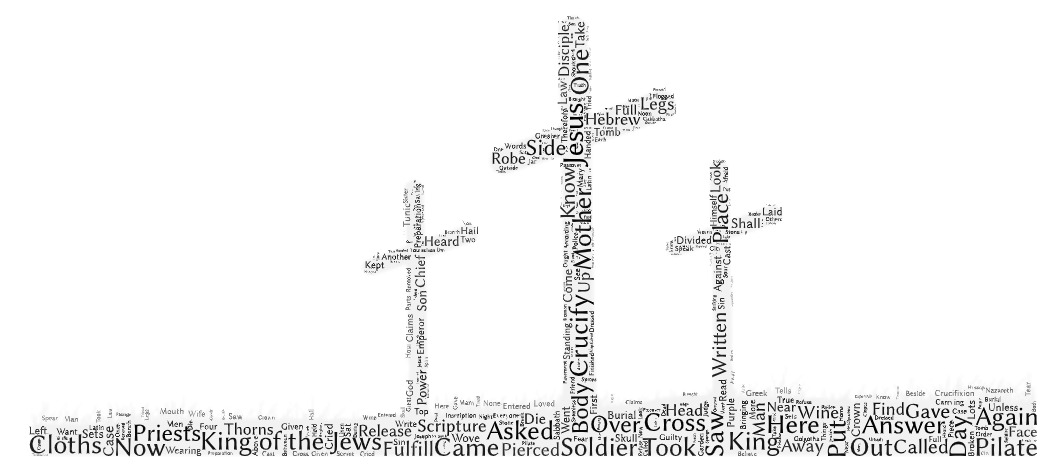
The torture and humiliation now begin in earnest.  And so does the political maneuvering between the Jewish leaders and Pilate, the Roman governor.  There is a tragic sense of fatalism - everything is happening as it has to happen, everyone is playing their allotted role.  Numerous times in this chapter the author tells us that scripture is fulfilled.


First, Pilate has Jesus whipped.  That in itself should be enough torture, but it doesn’t stop there.


Since Pilate has repeatedly called Jesus “King of the Jews”, the soldiers mock Jesus by making a crown of thorns and torture Jesus by putting this painful thing on his head.  They dress him in a purple robe, sarcastically say “Hail, King of the Jews”, and slap Jesus in the face.  


Pilate appears again before “them” (I surmise that this means the Jewish leaders who arrested Jesus and brought him to Pilate).  Jesus appears before them all, wearing the crown of thorns and the mocking robe of “royalty.”  Pilate twice says that he finds nothing to accuse Jesus of.  The chief priests and police call out “Crucify him!” and say that Jesus’ crime is that “he has claimed to be the Son of God.” (verse 7)


Pilate becomes afraid.  I guess he doesn’t want to get mixed up in a religious-political dispute.  Or he doesn’t want to choose between dissing the emperor or dissing the God of the Jewish people.  Pilate quizzes Jesus again, trying for a third time (a mirror image of Peter’s three denials?) to find a reason to free Jesus, but Jesus says nothing.  Pilate says, don’t you know I have supreme power over your life?  Jesus then responds that the only reason Pilate has power is that it was given to him “from above.”  


Again Pilate tries to release Jesus.  The Jewish leaders who oppose Jesus throw it back in his face - they say, if you let free this man who claims to be a king, then you are being disloyal to the Roman emperor.


Next Pilate tries to appeal to the people outside the Praetorium.  Are these just the Jewish leaders, or is it a crowd of people?  I think in this gospel it’s just the leaders.  The text notes that it was the “day of Preparation for the Passover, and it was about noon.”  I am not sure what this detail means. Is there likely to be a big crowd there at that time on that particular day? 


Pilate said to “the Jews”, (the leaders who oppose Jesus), “Here’s your king!” but they shout for Jesus to be crucified.  Pilate:  You want me to crucify your king?  The chief priests declare that the Roman emperor is their only king. So Pilate sends Jesus to be crucified.


As this gospel tells it, Jesus has to carry his own cross, walking to The Place of the Skull, Golgotha, the place of the crucifixion. 


There are few details in this gospel about the mechanics of crucifixion, but suffice to say that it is an extremely cruel, humiliating, and torturous way to die. They place Jesus on a cross between two other criminals.  Pilate arranges for a sign to be on Jesus’ cross that says, “Jesus of Nazareth, King of the Jews.” The text specifies that the sign is written in Hebrew, Latin, and Greek. Anybody and everybody should be able to read it.  The Jewish chief priests object to this label, but Pilate says, too bad.  “What I have written I have written.”  (verse 22).  


As Jesus hangs naked on the cross, slowly dying, the soldiers take Jesus’ clothes and divvy them up between them.  This is to fulfill a scripture.


Some of Jesus’ closest family and friends are standing nearby watching.  The first mentioned are women – Jesus’ mother, his mother’s sister, another Mary, and Mary Magdalene.  Jesus sees his own mother and “the disciple whom he loved” and bequeaths to his mother a new son, the disciple he loves.  This is heartbreakingly touching, and I think it is further fulfillment of Jesus’ prayer in Chapter 17:12 that “not one of them [Jesus’ followers] was lost”. 


Jesus senses that his death is near.  He says, in order to fulfill scripture, “I am thirsty.”  Those in charge put a sour-wine-soaked sponge on a branch of hyssop and hold it to Jesus’ mouth.

When Jesus had received the wine, he said, “It is finished.”  Then he bowed his head and gave up his spirit. (verse 30)


Every Good Friday, when I hear this story again, it never fails to give me chills.


The gospel author notes that “the Jews” do not want the bodies of the crucified people to remain on the crosses during the sabbath.  This next detail is gruesome, and does not appear in the other gospels.  In an additional cruelty, the soldiers break the legs of the two crucified criminals.  I looked this up, and the internet says that breaking the legs makes the crucified victims suffocate, and so would hasten death.  It would be less painful, I’m sure, if the soldiers just ran them through with a sword. But this is the Roman system of punishment, and the point is to make the punishment as cruel as possible. 


But Jesus is already dead, so the soldiers do not break his legs, which the text says is a fulfillment of a scripture.  The soldiers do stick a spear into the gut of Jesus, and blood and water pour out.  This is also to fulfill a scripture.


Joseph of Arimathea is a secret disciple of Jesus.  He asks Pilate to let him have the body of Jesus; Pilate agrees.  Nicodemus (of Chapter 3, the Jewish leader who “had at first come to Jesus by night”) also arrives with burial spices.  The two men prepare Jesus’ body with the burial spices and linen.  And then they place the body into a nearby tomb which had never before been used.


Tuesday, April 12, 2022

The Gospel of John, Chapter 17: Prayer


The Gospel of John, Chapter 17: Prayer


Read Chapter 17 here.


Chapter 17 consists entirely of a prayer Jesus prays.  Sometimes Jesus speaks of himself in the third person.  The language is liturgical and repetitive. In Eugene Peterson’s The Message translation (link above), it appears as a poem or psalm.  I’ll take it in the opposite direction, and summarize with (gasp) bullet points:


  • Glorify your Son so the Son may glorify you (third person)

  • He has authority over all people (third person)

  • He can give eternal life (third person)

  • Eternal life means knowing you, God and Jesus Christ whom you sent.

  • I (switch to first person) made your name known to those whom you gave me.

  • They received the words from you.

  • I am asking on their behalf.

  • Protect them.

  • The world has hated them because they do not belong to the world.

  • Protect them from the evil one.

  • Make them holy in the truth.

  • And I also ask on behalf of future believers, those who will believe in me [through the words of the disciples]


The top 12 words in the prayer are:

World

Given

One

Know

Sent

Word

Father

Glorify

Gave

Ask

Behalf

Love


My word counter (wordart.com) eliminates small connecting words like “in”, but this passage has a lot of the preposition “in” + pronoun:  in me, in you, in them, in us.  There is a lot of “being in.” 


At the start of this Chapter 17 prayer Jesus says: 

“Father, the hour has come; glorify your Son so that the Son may glorify you, since you have given him authority over all people, to give eternal life to all whom you have given him. 3 And this is eternal life, that they may know you, the only true God, and Jesus Christ whom you have sent.  I glorified you on earth by finishing the work that you gave me to do. So now, Father, glorify me in your own presence with the glory that I had in your presence before the world existed. (verses 17:1-5)


Lots of glorifying there.  Glorify means “to praise, extol, magnify, celebrate, honor.” (Strong’s Concordance)


In verses 1-5 which I quoted above, we see some of the themes from the opening words from Chapter 1:

In the beginning was the Word, and the Word was with God, and the Word was God.  He was in the beginning with God. All things came into being through him, and without him not one thing came into being. What has come into being in him was life, and the life was the light of all people. …. 

And the Word became flesh and lived among us, and we have seen his glory, … No one has ever seen God. It is God the only Son, who is close to the Father’s heart, who has made him known.

- Chapter 1, verses 1-4, 14, 18.


In his prayer Jesus also recalls the Logos (Word) of Chapter 1:

  • I have made your name known to those whom you gave me from the world. They were yours, and you gave them to me, and they have kept your word. (verse 6)

  • I have given them your word, and the world has hated them because they do not belong to the world, just as I do not belong to the world. (verse 14)

  • Sanctify them in the truth; your word is truth. (verse 17)

  • I ask not only on behalf of these, but also on behalf of those who will believe in me through their word,  that they may all be one. (verse 20-21a)

In each of these verses “word” is “logos” in Greek.  It can have so many layers of meaning in this prayer.


Jesus prays for protection from evil for his followers, present and future.  


Jesus ends his prayer with a request for God’s love to be in his followers:

 “Righteous Father, the world does not know you, but I know you; and these know that you have sent me. 26 I made your name known to them, and I will make it known, so that the love with which you have loved me may be in them, and I in them.” (verses 17: 25-26)


Jesus’ prayer includes many of the themes we’ve seen all along in this gospel, as you can probably tell from the list of the top 12 words (above).  The prayer is infused with a poetical sense of belonging, loyalty, unity.  It’s so poignant, juxtaposed with the upcoming separation that Jesus is facing.


In the next chapter Jesus will begin the painful and humiliating path to death on the cross.


Monday, April 11, 2022

The Gospel of John, Chapter 16: I Have Conquered the World


The Gospel of John, Chapter 16: Conquered the World


Read Chapter 16 here.


This chapter is a continuation of Chapters 14-15, with Jesus imparting his wisdom to the disciples.


Don’t stumble

Things are going to get very difficult, and you will even be killed.  When that happens, remember that I (Jesus) told you it would happen.


Mishmash of contradictions

“But now I am going to him who sent me, yet none of you asks me, “Where are you going?”  (verse 16:5)

Yes they did, back in Chapter 14.


Jesus continues - it’s to your advantage for me to go, because otherwise the Helper (Holy Spirit) will not come.  The Holy Spirit is going to point out how the world is wrong about sin, righteousness, and judgment.  I have a lot to more to tell you, but you are not ready to hear it yet.  The Holy Spirit will guide you.


You won’t see me, and then you will see me

Jesus says:

“A little while, and you will no longer see me, and again a little while, and you will see me.” 

The disciples are confused by this statement.  Jesus says to them, you are going to be sad, but your sadness will turn into joy, because I will see you again.


Again Jesus repeats the theologically difficult statement that we heard in Chapter 14:

“Very truly, I tell you, if you ask anything of the Father in my name, he will give it to you. Until now you have not asked for anything in my name. Ask and you will receive, so that your joy may be complete.” (verses 16:23-24)


The wording in The Message translation:

“This is what I want you to do: Ask the Father for whatever is in keeping with the things I’ve revealed to you. Ask in my name, according to my will, and he’ll most certainly give it to you. Your joy will be a river overflowing its banks!

This wording changes the meaning to be more restrictive than “ask anything.” Probably for this very reason, many call The Message an interpretation rather than a translation.  But in reality every translation is an interpretation.  The Message makes more sense to me for these verses.


Figures of speech

Jesus admits that he has been speaking in figures of speech but  

“The hour is coming when I will no longer speak to you in figures, but will tell you plainly of the Father.”


The disciples say, yes NOW we understand everything you are saying.  And NOW we believe you came from God.  Jesus predicts that the disciples will be separated, and will face hardship.  He speaks words of hope:

“But take courage; I have conquered the world!”


Metaphors:  stumbling, seeing

Images and themes: troubles and pain to come, the Spirit, sorrow turning to joy

People/Beings:   Jesus, the disciples

Places: we lost the sense of place because this chapter consists of discussions with the disciples, not events.


Sunday, April 10, 2022

The Gospel of John, Chapter 15: Vine and Branches


The Gospel of John, Chapter 15: Vine and Branches


Read Chapter 15 here.


This chapter consists of aphorisms stated by Jesus.  Presumably this is to his beloved disciples, after their special dinner.  Jesus has a lot to impart to his disciples before the painful events of the week truly begin.  


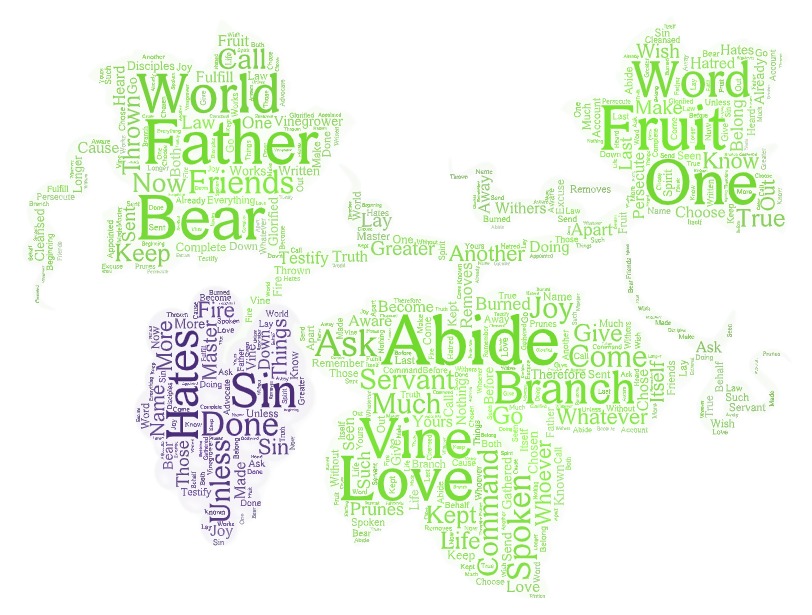
The most frequent word in this chapter (aside from prepositions and connecting words) is “abide”, which appears 11 times, usually in the phrase “abide in.”


I am the vine

We begin with another “I am” statement:

“I am the true vine, and my Father is the vinegrower.”  (verse 1) and

“I am the vine, you are the branches.” (verse 5)

You are going to get pruned (cleansed).  The point is for the vine to bear more fruit.  You’ve got to stay attached to me (Jesus) because, unattached, you can’t do anything. In fact you’ll be thrown into the fire and burned.  Stick with me and you will bear fruit.


In the middle of this vine metaphor, we also get a repeat of the “in me” statement of Chapter 14:

“Abide in me as I abide in you.” (verse 4)

This idea is repeated 4 times in slightly different ways in the first 10 verses.


My commandment: love one another

“If you keep my commandments you will abide in my love.”


And what are the commandments?  We get a repeat from Chapter 13:34-35:

“This is my commandment, that you love one another as I have loved you.  No one has greater love than this, to lay down one’s life for one’s friends.  You are my friends if you do what I command you.”

Jesus says to the disciples, I’m calling you friends instead of servants now because I’ve told you everything that I have heard from God.


“You did not choose me but I chose you.  And I appointed you to go and bear fruit…”


Nobody will like you

The world hated me (Jesus) first, and the world will hate you.  The gospel continues the black-and-white dichotomy between those who align with Jesus and those who don’t.  


Jesus refers to a mysterious thing he said back in Chapter 13:16, right after he washed the disciples feet: 

“Very truly, I tell you, servants are not greater than their master, nor are messengers greater than the one who sent them.”  

And here in 15:20 Jesus says:

 “Remember the word that I said to you, ‘Servants are not greater than their master.’ If they persecuted me, they will persecute you; if they kept my word, they will keep yours also.”  

I had originally surmised that the statement might mean “keep in your own lane; know your place.”  But here the meaning of the statement seems to be that Jesus’ disciples can expect to be treated the same way Jesus can be treated.  Jesus will be persecuted and so will the disciples.  


Testify

When the Spirit of Truth comes from the Father, the Spirit will testify on my (Jesus) behalf.  You also should testify.


Metaphors:  vine, vinegrower, branches, fruit; servants, master, friends; 

Images and themes:  stay connected to Jesus, commandment to love one another, the hatred of the “world”

People/Beings:   Jesus, disciples, God the Father., “the world”

Places: we have kind of lost the sense of place because this chapter consists of sermons, not events.


The Gospel of John, Chapter 14: The Road


The Gospel of John, Chapter 14: The Road

I've had these posts ready for a while, but had computer troubles, which is why I am posting several in one day.

Read Chapter 14 here:


Jesus has stated several times in this gospel: where I am going, you cannot come.  At the start of Chapter 14, Jesus contradicts that statement, with this beautiful and comforting speech:


“Do not let your hearts be troubled. Believe in God, believe also in me.  In my Father’s house there are many dwelling places. If it were not so, would I have told you that I go to prepare a place for you? And if I go and prepare a place for you, I will come again and will take you to myself, so that where I am, there you may be also. And you know the way to the place where I am going.” (verses 1-4)


In comfort level, this is akin to the metaphor in chapter 10:14-17, where Jesus says he is the good shepherd:

“I am the good shepherd.  I know my own and my own know me, just as the Father knows me and I know the Father.  And I lay down my life for the sheep.  I have other sheep that do not belong to this fold.  I must bring them also, and they will listen to my voice.  So there will be one flock, one shepherd.  For this reason the Father loves me, because I lay down my life in order to take it up again.”  (v 10:14-17)


It’s comforting and strengthening to have a place to belong.


Back to Chapter 14. 


The disciple Thomas contradicts Jesus, saying, but we don’t know where you are going; “How can we know the way?”  Jesus replies with another of the “I am” statements of this gospel: 

Jesus said to him, “I am the way, and the truth, and the life. No one comes to the Father except through me.  If you know me, you will know my Father also. From now on you do know him and have seen him. (verses 14:6-7)

There it is again, the black-and-white absolutism of this gospel.  It sounds like Jesus is saying, “It’s my way or the highway.” But perhaps the more important part of this passage is that Jesus reiterates a main theme of the gospel: Jesus is from God.  


Then the disciple Philip contradicts Jesus, saying in essence we have not seen the Father; please “show us the Father.”  Jesus is either disappointed or exasperated. Haven’t you been paying attention, Philip?  He exhorts Philip to believe with this squishy phraseology:

Believe me that I am in the Father and the Father is in me.

This is a repeat of what we’ve read in 6:45-47, 8:19-20, 10:14-15, and perhaps elsewhere in the gospel.  God is the one who sent Jesus.  If you see Jesus, you see God.


I want to pause a moment and go back to Jesus saying “I am the way.”  It sounds quite absolute, like trundling down a predetermined sluiceway, like a luge track.  But The Message translates this as “I am the road,”  The Message sounds more like traveling, walking somewhere, taking a journey with Jesus.


It's comforting and strengthening to have a traveling companion. 


Jesus says where he is going, sort of:  “I am going to the Father.” And then he makes a promise, a statement which has led to all kinds of bad theology, in my opinion:

“I will do whatever you ask in my name, so that the Father may be glorified in the Son.  If in my name you ask me for anything, I will do it.” (verses 13-14)

How many honest, praying people throughout the centuries have asked in Jesus’ name, but have been denied their request?  This has been argued away by saying things like, you are not a good enough Christian to have God listen to your prayer; you weren’t in the right humble frame of mind when you asked; you hadn’t confessed your sins right before you asked; your motivation was wrong - you weren’t asking in order to glorify God, you were asking for human reasons; what you asked for was not in God’s time.  


The Message translates this passage this way, with a little bit more restriction than “anything.”

“From now on, whatever you request along the lines of who I am and what I am doing, I’ll do it. That’s how the Father will be seen for who he is in the Son. I mean it. Whatever you request in this way, I’ll do.”


As I’ve said before, I just can’t dive into theodicy right now.  Not in the mood. Moving on.


Jesus makes the conditional statement “If you love me, you will keep my commandments” three times in this chapter. And Jesus promises to send an advocate, a helper, a friend – the spirit of truth – later to become known to Christians as the Holy Spirit.  Jesus uses the preposition “in” some more:  

In a little while the world will no longer see me, but you will see me; because I live, you also will live. On that day you will know that I am in my Father, and you in me, and I in you.  (verses 19-20)

This is the style of this gospel - short little words like “in” without a great deal of definition.  If you are “in” with Jesus, you will know what it means.  Jesus also hints at the resurrection.


At a very troubling time, when Jesus is about to leave them, he calms his disciples with these comforting words:

Peace I leave with you; my peace I give to you. I do not give to you as the world gives. Do not let your hearts be troubled, and do not let them be afraid. (verse 27)


Jesus predicts doom for himself, but says he is doing what God has commanded him to do.  And then, “Rise, let us be on our way.”


But in the next three chapters, the author inserts more speechifying before the action continues.


Metaphors: house/dwelling places, going/the way (the road)

Images and themes: coming and going, seeing the Father, 

People/Beings:  Jesus, the disciples (Thomas and Philip have speaking parts)  

Places: at the dinner table