Sunday, April 2, 2023

First Lines: March 2023 edition


Below are the first lines of the books I finished reading in March.   If there was a theme, it might be: women who were bold to fight for justice or break down barriers.


Book 1

The thing to know about me is this: if I’d been born just 10 years earlier and my parents hadn’t left Germany when they did, I would’ve been killed by Nazis. 


Book 2

Catalpa Tree

A catalpa can give two brown girls in western Kansas a green umbrella from the sun.


Book 3

Dear young girls, Home again from the deserts and oases of the Sheikdoms I find your enthusiastic letters on my desk. They have aroused in me the wish to tell you and many others who take an interest in our ancestors about these strange discoveries in Danish bogs.


Book 4

No one could have foretold how it was going to end.  Not even the murderer.


Book 5

I sometimes think of the Supreme Court oral arguments in Whole Woman’s Health v. Hellerstedt on March 2, 2016 as the last truly great day for women and the legal system in America. 


Book 6

I knew something was wrong as I turned the corner around the copse of black walnut trees where mourning doves roosted.  The stillness of the gray-breasted birds perched in a dull slash on a tree limb contrasted with the clamorous buzzing of thousands of bees.


Book 7

New York, 1887

“Miss Bly, you may leave.”


Did not finish - 

His cousin Freddie brought him on the heist one hot night in early June.


The titles and authors revealed:


Book 1

Rolling Warrior:  The incredible, sometimes awkward true story of a rebel girl on wheels who helped spark a revolution, by Judith Heumann with Kristen Joiner.  Audiobook, 4 hours, read by Allie Stroker,  Beacon Press Audio,   Published 2021.  215 pages in print form.


Memoir written for young adults.  Fascinating story of activism, well told.  Unbeknownst to me at the time, I downloaded this audiobook from the library on the day Judith Heumann died. She dedicated her life to improving life for all of us.


Book 2

World of Wonders: In Praise of Fireflies, Whale Sharks and Other Astonishments, by Aimee Nezhukumatathil.  Published 2020. 184 pages.


Memoir in essay form.  After each essay, I would declare to myself, that one was the most profound.  I recommend this book.


Book 3

Meet Me at the Museum, by Anne Youngson, Published 2018.  244 pages.


A second read, for book club this time.  I really enjoyed this book.  I found Tollund Man fascinating.


Book 4

Murder for Christmas, copyright 2017 by Francis Duncan.  Originally published in 1949 in the UK by John Long.  345 pages.  


A classic murder mystery with all of the suspects trapped in a big mansion during a snowstorm.  The detective’s name, Mordecai Tremaine, is pleasant to say.


The author’s identity is a mystery.  The author is listed as Francis Duncan and/or John Long.  But the notes at the beginning of the book say “Duncan’s daughter came forward to the publishers, revealing that Francis Duncan is actually a pseudonym for her own father, William Underhill, who was born in 1918.”  Where does the name John Long come from?  That is never explained.


Wikipedia says: Francis Duncan was the pen name of William Underhill (1918–1988), a British writer who published over twenty works of detective fiction between 1938 and 1959. Later in his career he also wrote five historical romances (as Hilary West) and children's fiction (as Robert Preston). 


Book 5

Lady Justice:  Women, the Law and the Battle to Save America, by Dahlia Lithwick.  Published 2022.  284 pages (text).  With endnotes 369 pages.  


Heartrending accounts of lawyers battling against the cruelties brought to us by the Trump presidency during and after that man and his cronies’ time in the highest office of the land.   What was most fascinating to me was how the author involved her son in some of the events. 


This book reminded me that  I would like to learn more about Pauli Murray and Constance Baker Motley.


Book 6

Death by a Honeybee: A Josiah Reynolds Mystery 1, by Abigail Keam.  Published 2014.  223 pages.  


I needed a light read, and this fit the bill.  This is by the same author as Murder Under a Blue Moon, which I read last month and liked a little better than this one.


Book 7

The Incredible Nellie Bly: Journalist, Investigator, Feminist, and Philanthropist.  Graphic biography. By Luciana Cimino, Illustrator Ergio Algozzino.  Translated by Laura Garofalo.  Originally published in Italian in 2019.  English translation 2021. 138 pages.


In the art work, I found it difficult to differentiate between the young Nellie Bly (late 1800s) and the young journalist (1922) interviewing the elderly Nellie Bly.  The story skipped around time frames a lot, which is not necessarily a problem, but there was no visible break that I could see.  That said, I did learn that: Nellie Bly got her start in Pittsburgh.  Nellie Bly was the pen name of Elizabeth Jane Cochran.  She did other groundbreaking journalism besides going undercover in the asylum for mentally ill women.   


Did not finish 

The Harlem Shuffle, by Colson Whitehead, Published 2020.  for book club.


Whitehead is an excellent writer, but the subject matter was too tense for me at the time.  I got about a quarter of the way through, but stopped in the part about Pepper during the war, where a violent act is described in detail.


Wednesday, March 29, 2023

Oy Vey Begorra!


Gratuitous photo of Irish Soda Bread,
which has little to do with this post
but looks a lot better, even with the
burnt raisins and all, than the
raw meat pictured below.

On March 15th the Common Household Husband pranced into the house, delighted, and presented me with a beef brisket.  He was very excited. He claimed it was right at the front of the grocery store and that it was so exciting to have one of his favorite meats right there within easy reach.  And on sale! his mother exclaimed from beyond the grave.  

I doubted his story, as whenever I have wanted a beef brisket for Passover I have had to request it from the butcher at the grocery store.  It takes them a good while to trim it, and it is never on sale.


Two food items I don't particularly like:
Samoa Girl Scout Cookies and
raw corned beef brisket.

But it turned out it was a corned beef brisket.  It was at the front of the store in sale-ebration of that Americanest of holidays (third after Superbowl Sunday and Cinco de Mayo), St. Patrick’s Day.


Oy vey iz mir! Corned beef is not Irish (nor Cornish, which would be reasonable to assume) but hails from Eastern Europe.  For those who would like to explore the history of corned beef, I am here to provide: The link.  As the article says: 

...what we think of today as Irish corned beef is actually Jewish corned beef thrown into a pot with cabbage and potatoes.


I have no idea how to cook corned beef.  I don’t even like corned beef.  But by Friday (St. Patrick’s Day) I realized I had to do something with our bovine windfall. I girded my loins and set my face toward the kitchen.


There is no way that a food with that many 
mentions of sodium can be healthful for us.


I looked up some slow cooker recipes.  They are written as if the cook is intending to make corned beef, wants to make corned beef, even to the point of wanting to pick which kind of cut to buy.


Having seen a photo of some meat-n-spices on Facebook I had an inkling that some kind of corny spices would be required to make corned beef.  I imagined I would have to pickle the meat in those spices for several days, but I was wrong.  Nevertheless, we had no set of spices, and no knowledge of what those spices should be.


This photo does not fully
reveal the disgustingness of the
contents of the meat package.


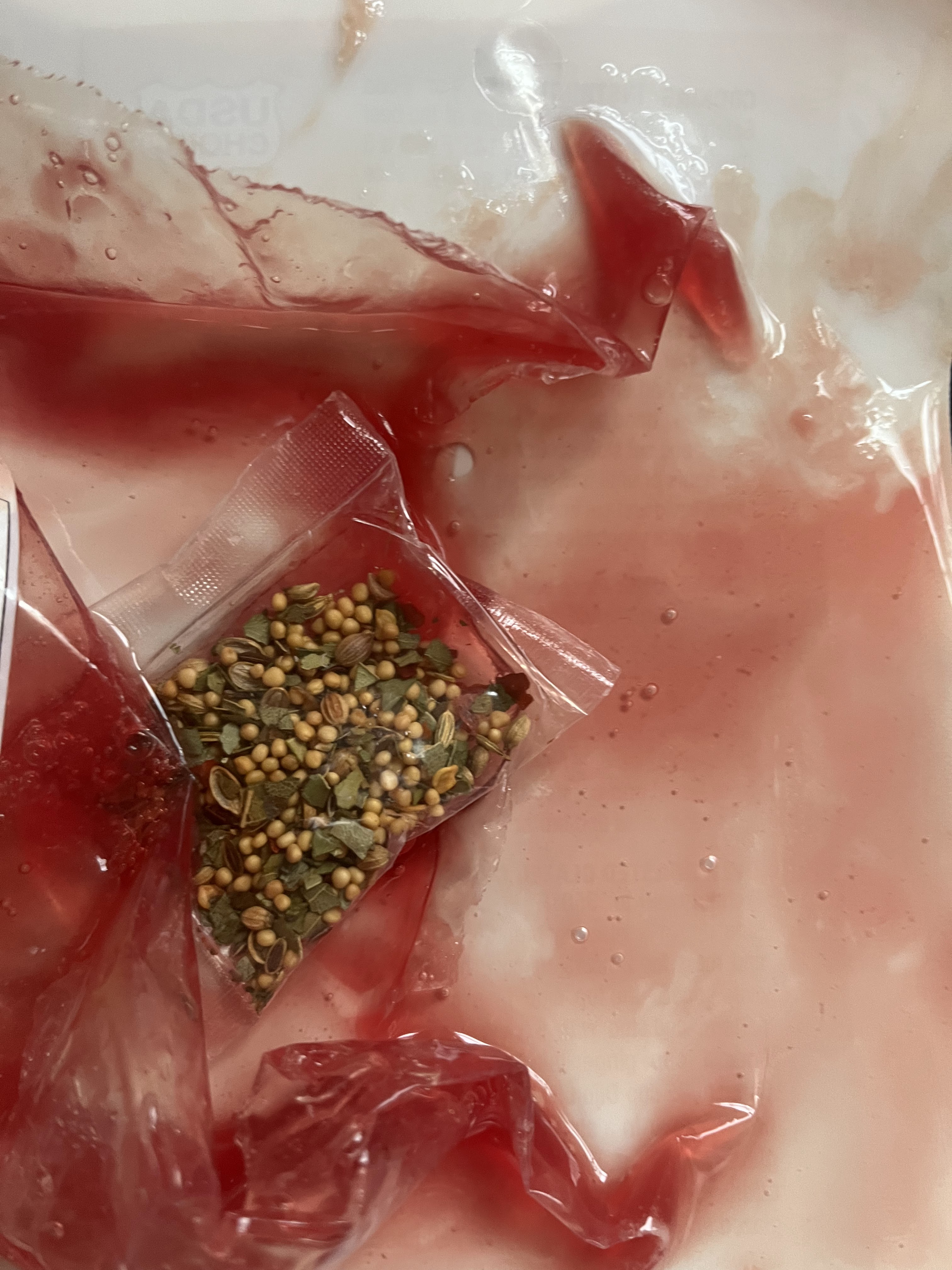
Lo and behold, nestled in the mucky fat-blood mixture surrounding the meat was a “flavor packet”.  I could no longer use lack of spices as an excuse to escape cooking the corned beef, but did have to pause to get over the disgustingness of the beef schmaltz.


The flavor packet, washed in the blood,
and then washed in the sink.


I ended up mostly using the recipe on the meat package.  I put sliced onions in the bottom of the crockpot, put the hunk of corned beef brisket on top, then the spices from the flavor packet, and finally surrounded the meat with water, just like a fleshpot of Egypt.  Other recipes exhorted me to add things like carrots, potatoes, cabbage, and beer, but I had little interest in the outcome so I ignored those suggestions.  I cooked that sucker in the crockpot for about 8 hours.


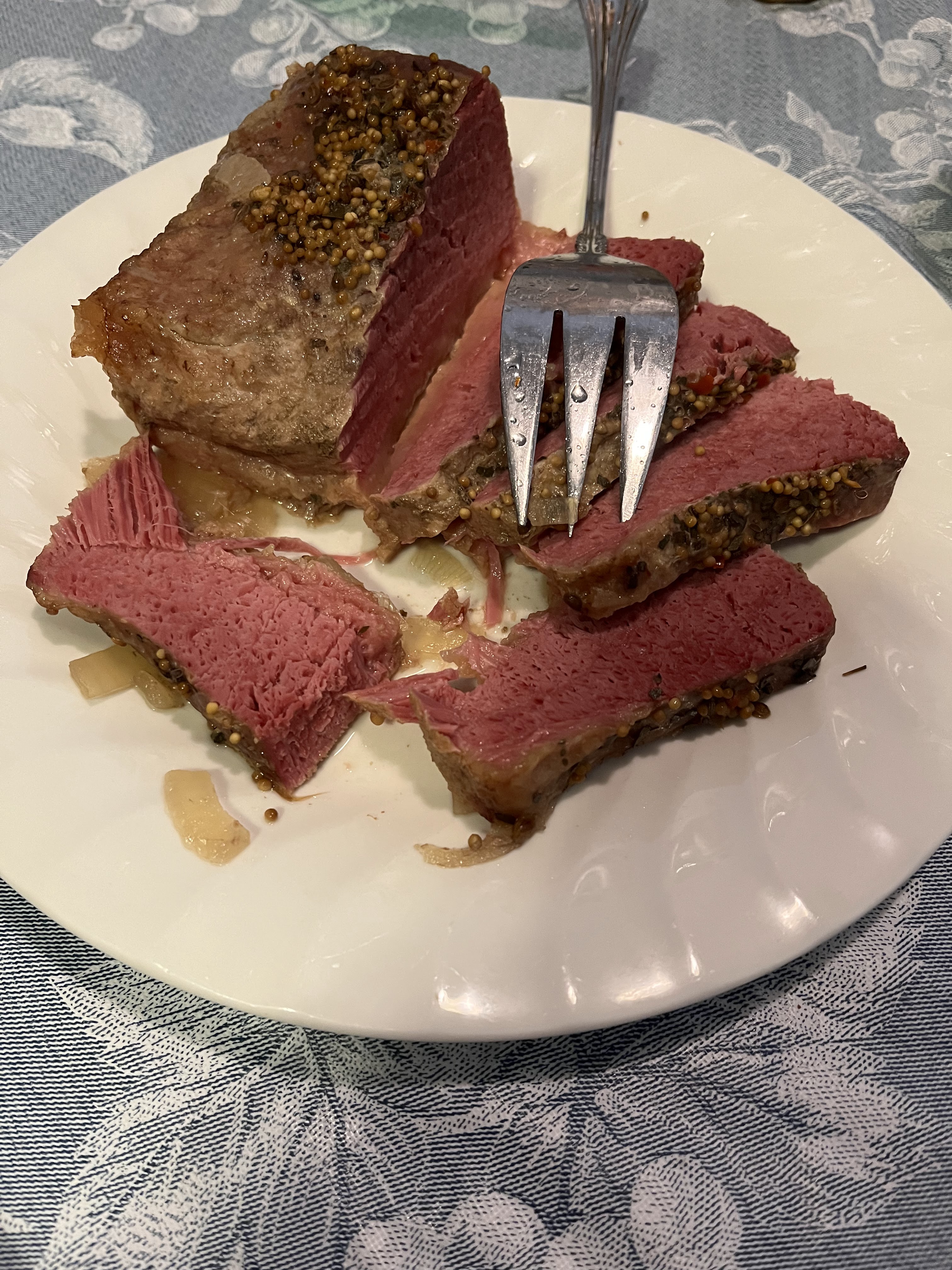
The result of my travails


The result was stupendous!  The Common Household Husband took one bite and was carried back to the joys of his childhood meals, just like the restaurant critic in the movie Ratatouille (in which the chef was a rodent).  Our corned beef brisket was declared to be Very Good, which is high praise around here.  It did not quite reach the gold standard which is “It’s as good as the steak at Harvey Kahn’s bar mitzvah.”


I remained distrustful of the corned beef but have to admit it was quite tender.  The best part was that it lasted for several days so I didn’t have to figure out what to have for dinner for two more days. I used the extra time to make Irish Soda Bread, which I find much more tasty.


Wednesday, March 1, 2023

First lines: February 2023 edition


Below are the first lines of the books I finished reading in February: four works of fiction and two non-fiction (one memoir which is children’s lit).

I have to add that Blogger was annoying this time around.  Why can't I copy-paste from a Google Doc to Blogger (a Google product) with all the formatting intact?  I had to reformat everything to keep the text from running off the end of the page here.  Not good, Google.


Book 1
Kamunting, Malaya, May 1931
The old man is dying. Ren can see it in the shallow breaths, the sunken face, and the skin stretched thinly over his cheekbones.


Book 2
November 1961
Back in 1961, when women wore shirtwaist dresses and joined garden clubs and drove legions of children around in seatbeltless cars without giving it a second thought; back before anyone knew there’d even be a sixties movement, much less one that its participants would spend the next sixty years chronicling; back when the big wars were over and the secret wars had just begun and people were starting to think fresh and believe everything was possible, the thirty-year-old mother of Madeline Zott rose before dawn every morning and felt certain of just one thing: her life was over.


Book 3
One billion. More than one billion people around the world are disabled. In fact, we’re the world’s largest minority.


Book 4
Part 1: The Disappearance
Chapter 1: Day 1: White Chucks, Size 10 ½
On the morning of the worst, most earth-shattering day of Ray McMillian’s life, he ordered room service: scrambled eggs for two, one side of regular bacon (for Nicole), one side of vegan sausage (for him), one coffee (for Nicole), one orange juice (for him).


Book 5
Mona Moon picked up her dusty knapsack and battered valise, making her way down the ship’s ramp where the New York City dock bristled with baggage porters, dock workers, cabbies, newspaper reporters, police, hustlers, and families welcoming loved-ones with flowers and kisses. There were no kisses and flowers for Mona.


Book 6
A Warrior Tradition
In the old tribal days, a Crow warrior had to perform four different types of war deeds – four coups – in order to become a chief.


The titles and authors revealed:

Book 1
The Night Tiger, by Yangsze Choo.  published 2019. 380 pages.

I liked the character Ren, and learned a little bit about a Confucian philosophical idea, but overall I did not enjoy this book. The plot is very creepy and involves bodily dismemberment of various kinds. I read it for book club.


Book 2
Lessons in Chemistry, by Bonnie Garmus, Published 2022, 386 pages.

This was quite an enjoyable, amusing, and yet infuriating book. What is it like to be “a woman scientist” (as opposed to “a scientist”) in the 1950s and 1960s? Over the top unfair and nearly impossible. Includes a self-aware canine. Splendidly told.


Book 3
Demystifying Disability: What to Know, What to Say, and How to Be An Ally, by Emily Ladau. Published 2021. 176 pages.

I recommend this informative book, which I read as part of my self-education. The initial chapter lays out various aspects of language on disability, which can be a touchy subject these days. For words used to address a person, there is Person First Language (PFL) e.g. “person with a disability” and Identity First Language (IFL) e.g. “disabled person”. The author writes: “Neither of these choices is wrong, though many people strongly prefer one over the other.” The difficulty with language proscriptions is that language changes over time, sometimes quite quickly. That doesn’t excuse us from keeping up, but it does mean, to me, that a certain amount of grace is in order. Emily Ladau has that grace.


Book 4
The Violin Conspiracy by Brendan Slocumb. Published 2022. 338 pages.

I enjoyed this mystery about a Black classical violinist and his violin. About half-way through, I decided it would be good to listen to some of the music pieces mentioned. I was not disappointed. Just take in The Dance of the Goblins by Antonio Bazzini!


Book 5
Murder Under a Blue Moon (a 1930s Mona Moon Historical Cozy Mystery Book 1), by Abigail Keam. Published 2019. 278 pages.

Mona inherits an estate from her uncle, who died under mysterious circumstances. Mona puts up with guff from no one. The story includes a lawyer with the surname Deatherage,which I could not decide how to pronounce. Deeeth-a-ridge? Death-a-rage? Either one seems to fit with a cozy mystery. Includes a noble manor house which is falling apart, horses, and the Kentucky Derby.


Book 6
Counting Coup: Becoming a Crow Chief on the Reservation and Beyond, by Joseph Medicine Crow. Audio book, unabridged, narrated by Henry Strozier, 2015 release, 2 hours. Print book published in 2006. 128 pages. Memoir; children’s lit.

This person’s life was fascinating to me. I admit that I used this audiobook as a sleep aid – and it worked – but I was interested enough that I went back to listen to most of it while fully awake. The internet reveals that the author, Joseph Medicine Crow, received the Presidential Medal of Freedom from President Barack Obama. Given the current educational environment I must hope that the story of this scholar and patriot will not be forbidden to students.


I would love to hear about what you are reading these days.


Saturday, February 11, 2023

Super Superb - Owls

I have an affinity for owls as expressed in art.  And sometimes in real life at the Aviary. 


When I was a kid I somehow acquired the likeness of an owl (stuffed, i.e. three dimensional) on a perch.  I think this was a Halloween decoration.  


When I was a young adult, at Christmas I received a gift in a large box.  It was the old trick - a box within a box within a box. 


And at the center of it all was my owl. This may have been my parents’ way of hinting that I should move my stuff out of their house already.  Eventually that happened but this gift was not the catalyst.


Despite that experience, I still like theoretical owls. I like the *idea* of owl.  I am all in for platonic owls.  Owls in art are superb.


I have nothing against real live owls but I don’t particularly want to become friendly with any owls.  I hope they are doing fine on their own.  And anyway, state law does not allow humans to adopt owls as pets.


Herewith some of my favorite depictions of Superb Owls.


Our own owl statue which stands 
guard at our front door.
With gladiolus flowers,
miraculously not devoured
by deer.


Restroom decor.  I think this was at a vegan restaurant.


Snowy Owl at the Aviary


A superb owl hook


Eastern Screech Owl at the Aviary


Owl planter - seen while canvassing


Our superb owl

Thursday, February 2, 2023

First Lines: January 2023 edition

Dusk falling in North Park

I look back wondering how I managed to finish eight books in January.  It was part holiday, part travel to the Old Folks Home, part insomnia.  But mostly an inexplicable lack of energy all month, probably due to the burst of energy required in December for me to do all the tasks that I put off until after the election. And we made SO many cookies in December!  January filled me with a great desire to hibernate, crawl under the covers and do nothing but read.  I was privileged to be able to do that, at least some of the time.

If there are themes emerging from this selection of books, they would have be forest, and justice, and justice for the forest.


Book 1

Rego Park, N.Y. c. 1958

It was summer, I remember.  I was ten or eleven.  I was rollerskating with Howie and Steve.  “Last one to the schoolyard is a rotten egg!”


Book 2

The world, as it is, is the enemy of God.  The world, as it is, is the enemy of the people of God.  


Book 3

Three-quarters of the way to the newsagent’s, a trek she will come to deeply regret, Millie Gogarty realizes she’s been barreling along in second gear, oblivious to the guttural grinding from the bowels of her Renault.


Book 4

SCENE I. Athens. The palace of THESEUS.

Enter THESEUS, HIPPOLYTA, PHILOSTRATE, and Attendants

THESEUS

Now, fair Hippolyta, our nuptial hour

Draws on apace; four happy days bring in

Another moon: but, O, methinks, how slow

This old moon wanes! she lingers my desires,

Like to a step-dame or a dowager

Long withering out a young man’s revenue.


Book 5

In the late spring of 1995, just a few weeks after I’d turned twenty-eight, I got a letter from my friend Madison Roberts. I still thought of her as Madison Billings.


Book 6

This book grew out of a series of Facebook posts designed to help guide Christians in the United States through the maze of issues that were debated during the presidential election in 2012.


Book 7

I remember now standing with my face to the horizon in the waist-deep tide of the Gulf of Mexico, making up a dance routine.


Book 8

First there was nothing.  Then there was everything.

Then, in a park above a western city after dusk, the air is raining messages.


Did not finish

Wheels Up

I am running late for the airport, trying to catch a cab on my street corner.  A woman in a wheelchair and her date, a man, arrive at the corner seconds after me.


The titles and authors revealed:


Book 1

The Complete Maus (Maus #1-2), By Art Spiegelman.  Nonfiction graphic book.  Part memoir. 296 pages. first published 1986.

This book has been challenged to be removed from school curricula.  It is a difficult book to read because of the subject matter, but I found no reason to ban it from high school curricula or libraries.  I did have to put it down for a few hours because of the harrowing story.  It reinforces how random was the possibility of survival for Jews in the Nazi regime.   There is plenty to discuss after reading this book. For starters: the author-artist’s choice to represent humans as animals, and by a different animal for each group of people (e.g. Jews, Nazis, Poles).


Book 2

Doing Justice: Congregations and Community Organizing, by Dennis Jacobsen.  Published 2001.  103 pages.

This book was a shocker to me, starting with those opening lines.  I didn’t feel that starting off by saying the world is the enemy is helpful for organizing.  But then I haven’t done any organizing.


Book 3

Good Eggs, by Rebecca Hardiman.  336 pages. Published 2021

Recommended by Pai.

Funny but also filled with off color language.  The frequency of the f-word was surprising to me, given that most of the characters are Irish.  Maybe my copy was Americanized? The book is also sad and tense.  This family was exhausting but I was compelled to read to the end to find out what happened.


Book 4

 A Midsummer Night's Dream by William Shakespeare.  256 pages. First published 1595.

For book club.  This was a relatively easy Shakespeare to understand.  Two of my kids and I read it out loud in the living room, which was a blast.  I’ve got to find time to watch a movie version, because the part with the wall has got to be even more hilarious on stage. This play involves a lot of traipsing about the forest. "Into the woods, and who can tell what's waiting on the journey?"


Book 5

Nothing to See Here, by Kevin Wilson.  Published 2019.  277 pages.

This book  examined parenthood from a unique perspective, but I thought it was a bit repetitive and tense.  Not as funny to me as others’ Storygraph reviews claimed.  But this could be because I am just tense myself. That said, there's quite a lot to think about when reading this book.


Book 6

Public Faith in Action: How to Think Carefully, Engage Wisely, and Vote with Integrity, by Miroslav Volf, Ryan McAnnally-Linz.  240 pages. Published 2016.

The authors expound on the commitments, convictions, and virtues that they feel should guide those seeking to lead a faithful Christian life.  The book has a beatitude-like list of political and social goals for our society, but also asks valid questions.  They do not address if and how Christians should support democracy; the existence and continuation of democracy is a given.  In 2016 most of us did not see a threat to democracy.


Book 7

Bomb Shelter: a memoir in essays, by Mary Laura Philpott.  Published 2022. 288 pages.  Essays about anxiety and optimism.  Includes a very good description of vertigo.  I enjoyed it.  More essay collections, please.


Tree roots on forest floor, far below the overstory

Book 8

The Overstory, by Richard Powers.  2018.  502 pages.  Pulitzer Prize winner.

 An extraordinary book that left me with questions, although the main thesis is consistent and strong.  If you have time to read a long book, I recommend this one.  It’s about trees and forests, but also a revealing portrait of activism.


I admire a writer who structures the book according to the theme (e.g. All the Light We Cannot See).  At around page 70 of The Overstory I decided that this was not, in fact, a novel, but a collection of short stories.  I was wrong.  The first 150 pages are the roots --  in-depth expositions of the nine (!) major characters. If I had bothered to read the Table of Contents I would have realized that from the beginning.   In the Trunk, Crown, and Seeds sections, we see how the characters branch out, and into each others’ lives. 


In the prologue, the trees tell us humans:

Your kind never sees us whole.  You miss the half of it, and more.  There’s always as much belowground as above.

Human that I am, surely I have missed deep points and clever details. It’s a longish book (502 pages), yet the characters and plot swept me right along.  I wish I could have lingered with it, but I finished it with only one day to spare before the library snatched back the e-book.  


A recent word from the author: Five Years Ago, I Wrote a Fictional Disaster That Is Now Playing Out in Real Time.  Feb 2, 2023 New York Times.


Did not finish

Look Alive Out There, by Sloane Crosley.   Essays.  Published 2018.  257 pages.

Parts were very funny.  But also snarky.  I was not in the mood for this level of snark.