Saturday, February 11, 2023

Super Superb - Owls

I have an affinity for owls as expressed in art.  And sometimes in real life at the Aviary. 


When I was a kid I somehow acquired the likeness of an owl (stuffed, i.e. three dimensional) on a perch.  I think this was a Halloween decoration.  


When I was a young adult, at Christmas I received a gift in a large box.  It was the old trick - a box within a box within a box. 


And at the center of it all was my owl. This may have been my parents’ way of hinting that I should move my stuff out of their house already.  Eventually that happened but this gift was not the catalyst.


Despite that experience, I still like theoretical owls. I like the *idea* of owl.  I am all in for platonic owls.  Owls in art are superb.


I have nothing against real live owls but I don’t particularly want to become friendly with any owls.  I hope they are doing fine on their own.  And anyway, state law does not allow humans to adopt owls as pets.


Herewith some of my favorite depictions of Superb Owls.


Our own owl statue which stands 
guard at our front door.
With gladiolus flowers,
miraculously not devoured
by deer.


Restroom decor.  I think this was at a vegan restaurant.


Snowy Owl at the Aviary


A superb owl hook


Eastern Screech Owl at the Aviary


Owl planter - seen while canvassing


Our superb owl

Thursday, February 2, 2023

First Lines: January 2023 edition

Dusk falling in North Park

I look back wondering how I managed to finish eight books in January.  It was part holiday, part travel to the Old Folks Home, part insomnia.  But mostly an inexplicable lack of energy all month, probably due to the burst of energy required in December for me to do all the tasks that I put off until after the election. And we made SO many cookies in December!  January filled me with a great desire to hibernate, crawl under the covers and do nothing but read.  I was privileged to be able to do that, at least some of the time.

If there are themes emerging from this selection of books, they would have be forest, and justice, and justice for the forest.


Book 1

Rego Park, N.Y. c. 1958

It was summer, I remember.  I was ten or eleven.  I was rollerskating with Howie and Steve.  “Last one to the schoolyard is a rotten egg!”


Book 2

The world, as it is, is the enemy of God.  The world, as it is, is the enemy of the people of God.  


Book 3

Three-quarters of the way to the newsagent’s, a trek she will come to deeply regret, Millie Gogarty realizes she’s been barreling along in second gear, oblivious to the guttural grinding from the bowels of her Renault.


Book 4

SCENE I. Athens. The palace of THESEUS.

Enter THESEUS, HIPPOLYTA, PHILOSTRATE, and Attendants

THESEUS

Now, fair Hippolyta, our nuptial hour

Draws on apace; four happy days bring in

Another moon: but, O, methinks, how slow

This old moon wanes! she lingers my desires,

Like to a step-dame or a dowager

Long withering out a young man’s revenue.


Book 5

In the late spring of 1995, just a few weeks after I’d turned twenty-eight, I got a letter from my friend Madison Roberts. I still thought of her as Madison Billings.


Book 6

This book grew out of a series of Facebook posts designed to help guide Christians in the United States through the maze of issues that were debated during the presidential election in 2012.


Book 7

I remember now standing with my face to the horizon in the waist-deep tide of the Gulf of Mexico, making up a dance routine.


Book 8

First there was nothing.  Then there was everything.

Then, in a park above a western city after dusk, the air is raining messages.


Did not finish

Wheels Up

I am running late for the airport, trying to catch a cab on my street corner.  A woman in a wheelchair and her date, a man, arrive at the corner seconds after me.


The titles and authors revealed:


Book 1

The Complete Maus (Maus #1-2), By Art Spiegelman.  Nonfiction graphic book.  Part memoir. 296 pages. first published 1986.

This book has been challenged to be removed from school curricula.  It is a difficult book to read because of the subject matter, but I found no reason to ban it from high school curricula or libraries.  I did have to put it down for a few hours because of the harrowing story.  It reinforces how random was the possibility of survival for Jews in the Nazi regime.   There is plenty to discuss after reading this book. For starters: the author-artist’s choice to represent humans as animals, and by a different animal for each group of people (e.g. Jews, Nazis, Poles).


Book 2

Doing Justice: Congregations and Community Organizing, by Dennis Jacobsen.  Published 2001.  103 pages.

This book was a shocker to me, starting with those opening lines.  I didn’t feel that starting off by saying the world is the enemy is helpful for organizing.  But then I haven’t done any organizing.


Book 3

Good Eggs, by Rebecca Hardiman.  336 pages. Published 2021

Recommended by Pai.

Funny but also filled with off color language.  The frequency of the f-word was surprising to me, given that most of the characters are Irish.  Maybe my copy was Americanized? The book is also sad and tense.  This family was exhausting but I was compelled to read to the end to find out what happened.


Book 4

 A Midsummer Night's Dream by William Shakespeare.  256 pages. First published 1595.

For book club.  This was a relatively easy Shakespeare to understand.  Two of my kids and I read it out loud in the living room, which was a blast.  I’ve got to find time to watch a movie version, because the part with the wall has got to be even more hilarious on stage. This play involves a lot of traipsing about the forest. "Into the woods, and who can tell what's waiting on the journey?"


Book 5

Nothing to See Here, by Kevin Wilson.  Published 2019.  277 pages.

This book  examined parenthood from a unique perspective, but I thought it was a bit repetitive and tense.  Not as funny to me as others’ Storygraph reviews claimed.  But this could be because I am just tense myself. That said, there's quite a lot to think about when reading this book.


Book 6

Public Faith in Action: How to Think Carefully, Engage Wisely, and Vote with Integrity, by Miroslav Volf, Ryan McAnnally-Linz.  240 pages. Published 2016.

The authors expound on the commitments, convictions, and virtues that they feel should guide those seeking to lead a faithful Christian life.  The book has a beatitude-like list of political and social goals for our society, but also asks valid questions.  They do not address if and how Christians should support democracy; the existence and continuation of democracy is a given.  In 2016 most of us did not see a threat to democracy.


Book 7

Bomb Shelter: a memoir in essays, by Mary Laura Philpott.  Published 2022. 288 pages.  Essays about anxiety and optimism.  Includes a very good description of vertigo.  I enjoyed it.  More essay collections, please.


Tree roots on forest floor, far below the overstory

Book 8

The Overstory, by Richard Powers.  2018.  502 pages.  Pulitzer Prize winner.

 An extraordinary book that left me with questions, although the main thesis is consistent and strong.  If you have time to read a long book, I recommend this one.  It’s about trees and forests, but also a revealing portrait of activism.


I admire a writer who structures the book according to the theme (e.g. All the Light We Cannot See).  At around page 70 of The Overstory I decided that this was not, in fact, a novel, but a collection of short stories.  I was wrong.  The first 150 pages are the roots --  in-depth expositions of the nine (!) major characters. If I had bothered to read the Table of Contents I would have realized that from the beginning.   In the Trunk, Crown, and Seeds sections, we see how the characters branch out, and into each others’ lives. 


In the prologue, the trees tell us humans:

Your kind never sees us whole.  You miss the half of it, and more.  There’s always as much belowground as above.

Human that I am, surely I have missed deep points and clever details. It’s a longish book (502 pages), yet the characters and plot swept me right along.  I wish I could have lingered with it, but I finished it with only one day to spare before the library snatched back the e-book.  


A recent word from the author: Five Years Ago, I Wrote a Fictional Disaster That Is Now Playing Out in Real Time.  Feb 2, 2023 New York Times.


Did not finish

Look Alive Out There, by Sloane Crosley.   Essays.  Published 2018.  257 pages.

Parts were very funny.  But also snarky.  I was not in the mood for this level of snark. 


Monday, January 30, 2023

Resolution Abandoned!

Morning note, 2015


I don’t make New Year’s resolutions.  Secretly, though, this year I did make one.


I have already failed to keep it. That’s the fate of most New Year’s resolutions.  Soon the foot traffic at the local gym will decrease.  Consumption of bacon will increase and the eating of lettuce will fall.  The world will return to the usual level of cussing and cussedness.


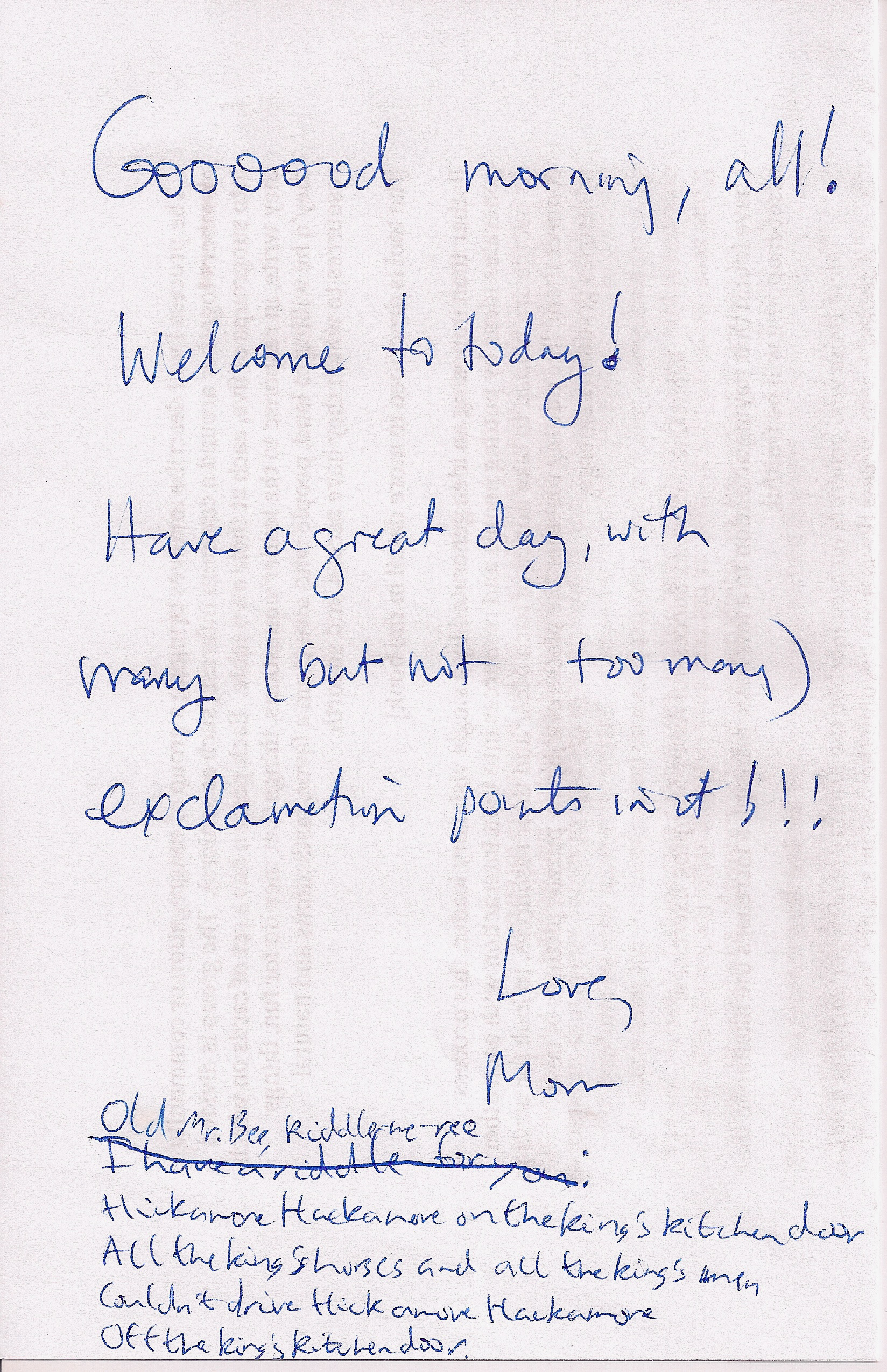
My New Year’s resolution was to use no exclamation points.  


Sometime in the 1980s, my brother the compiler programmer taught me that the exclamation point can also be called “bang”.  The punctuation combination (say that ten times fast) ?! can be called “interrobang”.  I find ?! to be quite useful in the modern world, as there is much that is surprisingly questionable.


The symbol ! is also used in math to denote factorial, which involves an enthusiastic increase in numerical value. 


Waffles!!!!!  Toast!!!!! Transmogrifier!!!!!
The meaning of this exclamation-point-laden written exchange
among Common Household family members
is lost in the sands of time.


The use of most punctuation has declined.  To denote the end of your sentence, you don’t need a period.  

Just send the message


Or even better send a gif


Which is pronounced with a hard g because otherwise it is peanut butter


I feel the reverse is true for the exclamation point.  The universe of words is awash in exclamation points.  Attempting to live exclamation-point-free will result in one’s written comments being misinterpreted as grumpy, conflicted, or downright hostile.  


Examples – someone posts online:  

I just got the job I wanted!

We just adopted a new pet!!  


My possible exclamation-less responses:

Great.

That’s just fabulous.


Inner reaction toward me from the original poster: You misanthrope! 


If I want to sound enthusiastic without using an exclamation point, I would have to use a lot more words, such as,

  • I am very glad you have been hired for the exciting job you were seeking as a professional paint drying watcher.  

  • That is so wonderful that you were able to adopt your new armadillo.  I applaud you for your care of animals.


I very quickly reverted to using an exclamation point in my responses.  This January has me feeling grumpy enough, without contributing to the feeling with waspish replies.


Cheerio!


As true in 2023 as it was in 2017.
Voting for judges is important
enough to warrant an exclamation point.


Friday, January 6, 2023

Selecting a Leader?

 Throughout history, humans have devised numerous methods for choosing leaders.

We in the Common Household want to do our part to provide viable ways to choose steady leadership.  Herewith, our illustrated list of ideas on how to select a leader. 


  • Science test

This is how Older Daughter studied for her
biology test in high school.  We could require
our leader to draw protist comic-book
 characters and name the parts of a flower.  


  • Twitter poll. Choose your bird carefully.


  • Baking contest


Anyone who can make cupcakes look like
mashed potatoes with butter and gravy wins.

  • Jar-opening contest

The first one to open all these jars
becomes supreme leader.


  • Folding a fitted sheet contest

Before the fitted-sheet-folding contest
begins, participants must be brave
enough to walk through this teen's room.


  • Art contest

Contestants must turn this into


this and then into


this without losing patience.


  • Whack a big rock with swords (the Dark Crystal method)

The candidates must use these tiny hors d'oeuvres swords 
to conquer this rock.


  • That's all I got. Sigh.

Saturday, December 31, 2022

Favorite books read in 2022


In 2022 I was fortunate to be able to finish 63 books, 41 fiction and 22 nonfiction.  Nine of those books were children's or young adult lit.

That is a total of 17,930 pages.  Here are the books I rated as excellent and as enjoyable:


Excellent Fiction


The Vanishing Half, by Brit Bennett, published 2020.  352 pages.


Meet Me at the Museum, by Anne Youngson.  Published 2018.  277 pages.


A Single Thread, by Tracy Chevalier.  Published 2019.  318 pages.


Excellent Nonfiction


How the Word Is Passed: A Reckoning with the History of Slavery Across America, by Clint Smith.  Published 2021.  The text ends at 288 pages.  With endnotes 353 pages.


Winter: Five Windows on the Season (The CBC Massey Lectures Book 2011), by Adam Gopnik.  219 pages of main text.  Total 274 pages. 


The Heartbeat of Wounded Knee:  Native America from 1890 to the Present, by David Treuer.  Published 2019.   455 pages (text); 512 pages including endnotes.


And some others I enjoyed quite a lot:

Essays of E.B. White, by E.B. White, published 1977 (essays were first published in various publications from 1934 through 1977).   346 pages.


The Three Escapes of Hannah Arendt: A Tyranny of Truth, by Ken Krimstein.  A graphic biography. Published 2018.  233 pages. 


Joy in the Morning, by P.G. Wodehouse.  Published 1946. 229 pages.


Miss Buncle Married, by D.E. Stevenson.  Published 1936, 352 pages.


The Thursday Murder Club By Richard Osman. Published 2020. 355 pages.


The Marble Staircase, by Elizabeth Fair.  Written 1950s?, published 2022.  210 pages.


Tess of the D’Urbervilles, by Thomas Hardy. Published 1891.  256 pages.


The Maid, by Nita Prose.  Published 2022.  280 pages.


The Christmas Train, by David Baldacci.  Published 2002. 273 pages.


Some second readings

Pride and Prejudice, by Jane Austen.  Published 1813. 


The Night Watchman by Louise Erdrich.  464 pages.  © 2020.  (Pulitzer prize winner).  


Born a Crime, by Trevor Noah.  Published 2016.  289 pages.


A Christmas Carol, by Charles Dickens, originally published 1843. 


Some of my reading stats, from thestorygraph.com

StoryGraph says that I have read 65 books, but maybe it is counting books I entered but didn’t finish.  StoryGraph seems to count as “classic” any book written before roughly 1950.  Okay. 


My top five genres for 2022 were “classics”, literary, historical, mystery, and history.  The only reason I read two thrillers is because of book club.


Creepily, the Washington Post also informed me that I had read 13,218 of their pages in 4,903 articles. I am pretty sure I did not read that many articles, although I might have clicked on that many articles.